


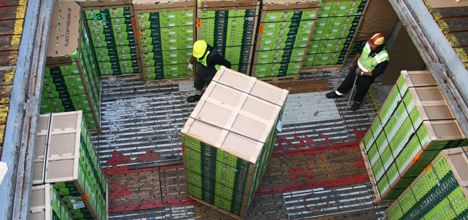
Kiwifruit export earnings are forecast to drop 20 per cent this season, according to the Ministry for Primary Industry's annual report.
The Ministry's Situation and Outlook for Primary Industries report released today reports kiwifruit earnings are expected to fall from over $1billion last season to $830million this season.
Kiwifruit earnings are expected to drop according to MPI's latest report.
Kiwifruit export volumes in the year to 31 March, 2014 are expected to fall 13 per cent to 88million with export prices for the same year expected to be lower than previous years due to exchange rate impacts.
In the medium term, export prices are expected to strengthen for both green and gold kiwifruit, driven by changes in market composition and the forecast depreciation of the NZD after 2015.
The progression throughout most North Island kiwifruit growing regions of the bacterial disease Psa-V is largely blamed for New Zealand exporting nine per cent fewer trays of kiwifruit in the year ended March 31, 2013.
However, higher in-market prices for kiwifruit held export revenue above $1billion.
Export volumes fell four per cent to 46million trays to Asia, and 10 per cent to 44million trays to Europe. Differences in the strength of consumer demand and varietal mix resulted in a significant difference in export revenue - $661million (up eight per cent) from Asia and $290million (down 16 per cent) from Europe.
The report also makes predictions about the success of the new gold variety G3, saying the worst case scenario is that Psa-V disease will reduce productivity of G3 by 40 per cent and the best case is that drop will only be 10 per cent.
The low scenario for gold kiwifruit production is based on no gold Hort16A production in the Bay of Plenty in 2014 (year to March 2015), and no production in other regions by 2015. This scenario also assumes a 40 per cent reduction in the productivity of G3 due to Psa, the report says.
The high scenario for gold kiwifruit production is based on no Hort16A production in the Bay of Plenty in 2016 (year to March 2017), and 20 per cent production in other regions at the end of the forecast period. This scenario assumes a 10 per cent reduction in the productivity of G3 due to Psa.
'It is prudent to forecast kiwifruit production within the bands of a low and high scenario due to the large amount of uncertainty of Psa progression, grower transition to G3, and the productivity impact of Psa on G3.”
Over time, research and development programmes will identify new kiwifruit varieties that are both tolerant of Psa and meet key attributes, such as taste and storage, that will make them commercially successful, says the report.
G3 has proven to be more tolerant, but not resistant to Psa-V, which was first confirmed in New Zealand in November 2010.
As at May 2013, more than 70 per cent of kiwifruit orchards were known to have the Psa-V, up from 40 per cent a year ago.
The main gold kiwifruit cultivar, Hort16A, is particularly susceptible to Psa. So far, more than 1500 hectares (about 60 per cent) of Hort16A has been removed because of the disease. This is expected to reduce export volumes of gold kiwifruit by around 43 per cent, to 13 million trays, for the year ending March 31, 2014.
Green kiwifruit orchards have also been infected with Psa, although they are proving to be more tolerant of the disease. Around 75 million trays of green kiwifruit are expected to be exported for the year ending March 31, 2014, a similar level to the previous year.
Warm, dry weather with high sunshine hours throughout summer and into autumn 2013 has led to fruit with higher dry matter, an indicator for fruit quality and taste.
The New Zealand kiwifruit industry has set in place a recovery pathway to replace the Hort16A cultivar with new gold kiwifruit varieties that are more tolerant of Psa, beginning with the transition to the G3 cultivar. G3 was commercialised in 2010 in small quantities, showing promising performance on-orchard, in the supply chain, and with consumers.
The National Psa-V Pest Management Plan that came into force on May 17, 2013, will help slow the spread of Psa and minimise its impacts on kiwifruit production.
Most of the Hort16A in the Bay of Plenty is expected to succumb to Psa over the next few years, although the timing is uncertain. Growers with healthy Hort16A vines may choose to defer the transition and continue to produce Hort16A for as long as possible. The production of Hort16A also depends on the uptake and success of new orchard management tools and practices to counter the impact of Psa, as well as the ability of growers to finance these activities.
MPI's production and export forecasts for gold kiwifruit over the medium term have two key drivers: the rate of transition to the G3 cultivar, and the productivity impact from Psa. The productivity impact includes the failure rate of new grafts and on-going impacts of Psa on the health of kiwifruit vines.

0 comments
Leave a Comment
You must be logged in to make a comment.