


Sixty years ago, ti-tree and rushes grew in swamp on either side of what is today the Paeroa-Tahuna Rd.
That was until young Malcolm Campbell and his father Samuel (then 65) began clearing the first of 500 acres (202 ha) to turn it into pasture.
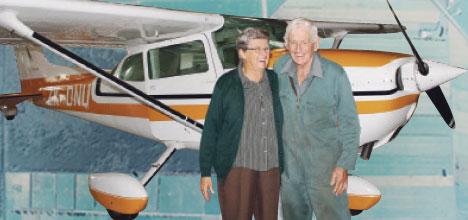
Aerial views of the former Campbell farm on the Paeroa-Tahuna Rd. Joan and Malcolm Campbell still have their first aircraft – a Cessna 172.
Malcolm and his wife Joan spent the next 50 years developing and farming the land, and along the way, built an airstrip and helped established an aero club which, for a short time, had the largest membership in the country.
The airfield is no longer home to an aero club and the couple has since sold the farm but the box hedging spelling out the words Te Aroha, and the airstrip's co-ordinate ‘10', which Joan had planted, remain a landmark on the roadside.
The Campbells have moved to a rural property near Waihi where Malcolm is writing the story of the farm, and the aero club, in a book he's calling ‘Us and Them' which will also take a dig at the bureaucracy he says is stifling farming, aviation and almost every aspect of life.
'You couldn't break in land today like we did 60 years ago. OSH and the Resource Management Act wouldn't let you do it,” he says.
Allis-Chamber
Malcolm used an Allis-Chamber tractor and a sickle bar mower, then later a D2 Caterpillar tractor and a heavy roller to clear ti-tree.
When he'd cut just enough to create a small area of pasture, Malcolm went to a sale to buy cattle. However, there weren't many fences and the animals headed off towards Tahuna, stopped only by the impenetrable swampland.
Bringing the entire farm into production took a long time. As the land was cleared, more than 19km of drains were dug and many kilometres of fencing built.
In 1974 Malcolm won a Farmers' Inventions competition with a pto-driven rotary drain cleaner and digger he built from a dished disc from a rotary slasher, pipe, angle iron, rotary slasher gear boxes and a seven foot long drive shaft. It was a very effective unit, and because it threw the 'muck” in a wide arc there were no big piles of material to flatten out later. 'I used to make sure I only cleaned the drains when the wind would blow the muck away from me,” says Malcolm.
Dairying
The farm was originally a dry stock unit. 'In 1980 we were getting $16 for lambs and that was good money and we were on parity with the American dollar, much as we are now.”
However, their son Ewan and employee Geof Keightley convinced them the future was in dairying so Malcolm, Ewan and Geof built a shed and introduced dairy cows.
Before the conversion, Malcolm fulfilled an ambition to learn to fly, taking lessons in 1962 with the Hauraki Aero Club under tutorship of the late Barry Hinton. Later, former World War II Catalina pilot Ken Fenwick initiated the idea of using the Campbell airstrip for more than spreading fertiliser.
'He asked if he and others could bring a few planes over on a Saturday and start teaching people to fly,” says Malcolm.
TEAL
Joan says the timing was just right. 'A lot of the commercial pilots had flown during the war and were close to retiring. The national airline TEAL was looking for younger pilots but there weren't many around, so aero clubs were training people.”
The first club house was an old pre-fabricated building Samuel Campbell bought for 40 pounds. It was later replaced by a new one, built by members. When the site of the airstrip changed, the hangar was fitted with old telegraph poles to create a sledge – towed across the farm by tractors. The first aircraft were Piper Cubs, Victa Airtourers and then Cessna 150s. The first instructor was a Malcolm Campbell – but not the one who owned the farm.
'It was quite a coincidence that his name was Malcolm. He was also married to a Joan and they had a son called David not much older than our son of the same name,” says Joan.
Airwomen
At $12 an hour, pilot training was within the reach of those who wanted to learn. Among them was Joan, who became one of a growing number of women taking to the skies to qualify as pilots in the 1970s. Nationally, they formed the New Zealand Airwomen's Association and took part in competitions throughout the country.
In 1974 Joan and Malcolm bought their first aircraft, which they still own, a Cessna 172 for $16,900. 'I reckon you'd pay closer to $300,000 for it now,” says Malcolm.
Together they flew the dual-control plane up and down New Zealand to other clubs, to visit friends and family, and to Great Barrier Island. In 2002 the couple flew across Australia, to Lord Howe and Norfolk Islands, and over the Tasman back to New Zealand.
Aqua Avis
The aero club, which operated from their farm, created a national storm when it became part of an ambitious plan to establish a new airline, flying domestic and international routes – not however, from the small Campbell airstrip.
'Club president Bruce McRae called a special meeting at which Matt Thomson of the Aqua Avia Society asked if our club wished to affiliate itself with the society and its plans to fly three DC8s and a DC9. The idea was to increase our membership to 80,000 at $2 apiece.
'In a very short time we had 30,000 members all with the right to fly as passengers on those aircraft making us the largest aero club in the country,” says Malcolm.
Entrepreneur Matt Thomson hoped to take advantage of a loophole in New Zealand's aviation regulations, which allowed members of a club or association to band together and charter an aircraft from an organisation with a charter license. The national airline was, at the time, Government-owned.
Club members voted in favour but the Government created so many obstacles and delays that Aqua Avia went out of business.
In semi-retirement, Malcolm and Joan have continued to be innovators, building a new home at Waitawheta with sweeping rural views and an efficient system of sun-tracking solar panels providing electricity.

0 comments
Leave a Comment
You must be logged in to make a comment.