


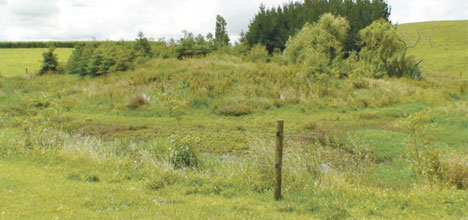
Wetlands are unique features of the New Zealand landscape. These can include lakes, ponds, lagoons, bogs, salt marshes and estuaries.
Landowners with significant wetlands on their properties should consider protecting and restoring them as important natural habitats.
Wetlands need to stay wet and be free from stock trampling them, to be effective filters.
Wetlands slow and filter water flowing off the land. In times of flood, water is absorbed by wetlands and is slowly released again in summer. This helps maintain flow in waterways, which is good for surface water takes and in-stream life.
Smaller wet areas, such as seeps, can also play a role in filtering pollutants from runoff and groundwater.
Wetlands
Once nitrogen has found its way into groundwater, it can be removed where it reappears at the surface (by plant roots growing out) in springs, wetlands and seeps. Keeping these areas wet and well-covered with grasses and rushes is essential for maximizing nitrogen removal.
There are a few conditions necessary for wet areas to be effective as filters.
• They must remain wet for all or most of the year.Many wet areas on farms have already been drained. For them to improve water quality, they'll need to stay wet.
• They must be fenced from stock. Most sedges, rushes and flax are palatable to stock. They need protection as they help to slow the flow, filter water, and provide a carbon source for the bacteria that remove nitrogen. Cattle trampling will also reduce the ability of wet areas to absorb water.
• They may need some planting. Native sedges, raupo, rushes and flax grow well in these areas. They can all be split and the sections planted out. Be careful with tree planting here. It can be counter-productive by drying out the soil and shading smaller plants.
Wetlands, seeps and swamps can also be used to filter runoff from tile and mole drains before it flows into streams.
Race and track runoff can be diverted into constructed wetlands as well. If this is done, care must be taken not to smother the area with sediment.
Temporary fencing
For areas which are inconvenient to fence permanently (those that are only wet in winter, for example), can still achieve improved water quality with temporary electric fencing.
This will help protect these areas from pugging and reduce the amount of sediment entering the waterway. Such areas may be grazed in summer when they naturally dry out.
This article is adapted from the seventh in a series of nine DairyNZ Farmfacts on managing waterways on farms.
They can be viewed at: www.dairynz.co.nz in the Farmfacts – Environment section.

0 comments
Leave a Comment
You must be logged in to make a comment.