


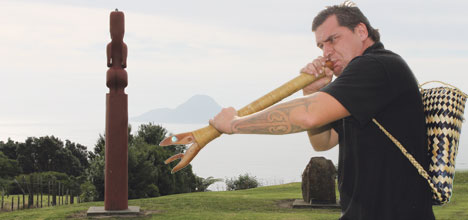
High on an ancient pa site, overlooked by a carving of his ancestor Toikairakau, William Stewart blows a carved Pukaea (wooden trumpet) in welcome.
There's a flax kete on his back but in his pocket is a sophisticated infra-red night vision monocular and close by are the antenna and receiver of a tracking device.
A Pukaea carved to represent a tuna (eel) is blown by William Stewart of NATIVconnectionz to welcome tourists.
Traditional and modern technologies are essential to the experience William and the team from NATIVconnectionz offer those taking part in the night-time Po Kiwi encounter in the Kohi Point Reserve above Whakatane.
It's just one of four unique and personal Maori experiences William, his cousins Britain Williams, Mita Manuel and their extended families offer visitors to the district.
Kiwi capital
'Whakatane claims to be the Kiwi Capital of the World because we have a population of kiwi living right on the town's doorstep, but few visitors get to see them so we thought we should do something about that,” says William, who moved to Whakatane from Auckland in 2010 with his family after completing a Bachelors of Management Studies degree at Waikato University and having a successful career with Tourism New Zealand.
'When our children were born my partner and I wanted to return to Whakatane to give them the kind of childhood I had enjoyed.”
The idea of starting a boutique tourism venture grew and the Po Kiwi night time experience seemed an obvious opportunity.
'As far as we know no other tour operator in New Zealand is using night vision equipment to see wild kiwi at night. We can't guarantee we will have an encounter but we take people into the bush in an area where we know kiwi are living, using tracking equipment to find them, and night vision gear to see them.”
Magic
Even if no kiwi are seen or heard, the experience of being with a small group of people on the summit of K?puterangi – the ancient strong hold of Toi – as dusk falls and being welcomed in Maori, and listening to legends of the land when entering the bush, weaves a kind of magic.
The five minute walk leads to a small clearing where the legend of 'how the kiwi lost its wings” is told, and people have the chance to familiarise themselves with the use of the night vision equipment. Meanwhile, guides use the tracking gear to locate one of several kiwi fitted with transmitters in the hope they may be near enough to see.
'If we are lucky, we will get to see and hear a kiwi as we are at a spot which borders the territories of three kiwi breeding pairs.”
Every effort is made to ensure the kiwi are not disturbed so those in the party are encouraged to stay still and quiet.
After a warming cup of kawakawa tea, the party returns to the car park for the drive to NATIVconnectionz headquarters and a hangi meal.
A percentage of the price of each tour goes to the Whakatane Kiwi Project. 'NATIVconnectionz can't take any credit for the kiwi being here. All the hard work has been done by the trust and we have a good relationship with them as our aims are to protect the kiwi and their habitat while giving people the chance to see them in the wild.”
In 1999, a few North Island brown kiwi were discovered in the reserve, southeast of Whakatane and south of Ohope. Miraculously, adult kiwi had survived without any predator control.
The discovery initiated the Whakatane Kiwi Project, at that time a partnership between Environment Bay of Plenty (now Bay of Plenty Regional Council) and Department of Conservation, in conjunction with Te Runanga o Ngati Awa.
Since then the Whakatane Kiwi Trust and the Whakatane District Council have also become partners in the project.
Today about 150 kiwi are under the management of the kiwi trust, which is rearing chicks in captivity until they are big enough to survive in the wild. While many of the birds are living in reserves, some are also on private land.
Authenic
The Po Kiwi experience is one of many offered by NATIVConnectioNZ and aimed at small groups of tourists, giving them an opportunity to spend time with local Maori enjoying what William describes as 'authentic and personal Maori cultural experiences”.
It took William a while to convince his whanau that the ideas he was suggesting for tourists would work. 'They couldn't understand why visitors would want to do the kind of things we take for granted, like a walk in the bush, a hangi meal or watching a local rugby match.”
Because of what he learned working for Tourism New Zealand and from travelling overseas, William knew quintessential Maori experiences do have appeal.
Eventually, he convinced the cousins and now NATIVconnectionz has put together a range of tour options which include playing golf at Ohope with Maori golfers and gathering pipi from the beach afterwards for a meal; watching a local rugby match, meeting teams, choosing the player of the day and witnessing the after-match speeches and haka; a guided tour of the Te K?putu Gallery; an ancestral river walk; fishing at traditional 'sweet spots” and learning how to cook hangi food and enjoy the feast afterwards.
'Whakatane is a great place to live and bring up a family but employment opportunities are limited and we hope NATIVConnectioNZ will grow so we can employ more local people, and stop them heading off to Aussie for jobs,” says William.
At the same time, the aim is to promote a pride in both ancient and modern Maori culture and share it with people from all round the world.
To find out more visit www.nativ.co.nz

0 comments
Leave a Comment
You must be logged in to make a comment.