


When Sione Vaka boards the flight home to Eua Island in September it will be money, not a chainsaw or electronic goods, he'll be taking with him.
'I came here to earn money to help my family back home,” says Sione – who for the past five years has been among the Tongan RSE seasonal kiwifruit workers employed by Hume Pack-N-Cool of Katikati.
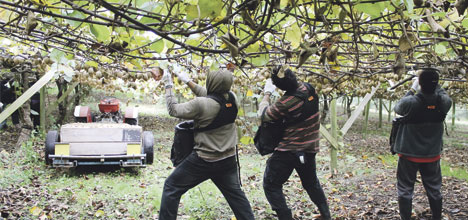
RSE workers from Tonga harvesting the last crop of Hort16A gold fruit from a Katikati orchard.
Other workers from the Pacific Islands often return home with lots of purchases made during their five months in New Zealand, but for Sione saving money for his family is more important.
Working in New Zealand has enabled him to support his mother and younger sister and improve the home they live in. This winter's kiwifruit work will provide funds to extend their house.
Crops
Sione says there is little employment opportunity on Eua, which has an area of 86.7square kilometres and a population of about 6000 people. The island is very fertile and it is easy to grow crops to feed the family, supplemented by fish from the sea.
It's a life in sharp contrast to New Zealand, but Sione has settled into the pattern of spending half his year in what most people would consider a tropical paradise, and the other half in New Zealand during winter.
Because of the time he has spent working for Hume and his ability and experience as a picker and pruner, Sione is considered by fellow Tongan employees as something of a leader. They look to him for guidance and he helps keep the picking and pruning gangs on task in the orchards.
Benefits
Sione's half-brother Simione Vakasiuola has worked for Hume since he was at school and is today the company's orchard sprayer and RSE supervisor.
He has clearly seen the difference the Registered Seasonal Employer scheme has made to Tongan workers and the country as a whole.
'On Eua people can grow enough food for everyday living and sell some of their vegetables, but there is no money for extras. When they come to New Zealand to work they are able to do more for their families, such as pay for education, improve their houses, maybe buy a car and set some money aside for savings,” says Simione.
'Some people are able to save enough to start their own business like one lady who now has a service station in Tonga.”
Simione says benefits are more than financial.
'People from different parts of Tonga form friendships while they are working in New Zealand, so it is good for the wider community. Some people even fall in love and marry.”
Fillipe
Sione stays with Simione and his wife Salome and family when he is in New Zealand so his arrival each April is something of a family reunion.
During his seven months here, he and other Tongan and overseas workers at Hume have the opportunity to explore the country, including a trip to the snow at Mount Ruapehu and to a Rugby World Cup Match in 2011.
It was Sione and Simione's father Fillipe who began the Hume connection with Tonga. In 1987 there was a fire in the packhouse and in an effort to find enough staff to re-pack undamaged fruit, Mark Hume contracted a gang of Tongan workers from Auckland, which included Fillipe.
'When the job was finished Fillipe said he enjoyed Katikati so much he didn't want to go back to Auckland so his wife and children joined him,” says Jim Hume, Hume Pack-N-Cool accounts manager.
Through Fillipe's contacts, each season Hume employed more Tongans who were residents in New Zealand to help with the harvest.
Siblings
Tragically in 1997, both Fillipe and his wife died within months of each other, leaving a large family including an 18 month old daughter without parents. Simione and his fiancee Salome, then in their teens, married to look after the five younger siblings.
Hume played a major role in the young family's life, offering employment, moral and practical support. The Katikati community rallied to their aid too, and local accountancy firm Young Oswald and Associates helped Simione and Salome buy a home.
The couple went on to have their own children and the family is now firmly part of the wider community, involved in sports, service organisations and the schools.
When the RSE scheme opened the opportunity to employ seasonal workers from the Pacific and with its existing strong links with the Tongan community in New Zealand, Humes decided to focus on Tonga as a source of additional labour. This season, 70 RSE workers from Tonga are part of the 350-strong Hume staff.
Humbling
Kate Krom, Hume human resources manager, says today the postharvest company is one of the largest employers of people from Tonga.
'It is quite humbling to go to Tonga and learn how important the kiwifruit work is to the people there. One of our staff is the only member of a very large family who has a regular income and he uses what he earns to help his family.
'Because we have only one packhouse facility we operate round the clock at the height of the season. The RSE workers are a welcome addition to our valued local workforce and provide consistent numbers for our dedicated night shift.”
Jim says life in Tonga is very different from New Zealand and he is impressed at how the Hume workers cope with the change in culture and climate.
'They work very hard while they are here and those who have been here a few times are used to the contrast, but the first time they come it must be a shock to step off the plane in Auckland and drive two hours through traffic to Katikati.
'RSE work is very important to the island because there is little employment and no social welfare.”
Kate is always impressed at the number of New Zealand resident relations who greet the workers at the airport when they arrive.
'They come armed with warm clothing because they know their relations from the islands won't have what they need to keep warm here.”
The Recognised Seasonal Employer Work scheme is a government policy allowing the temporary entry of additional workers from overseas to plant, maintain, harvest and pack crops in the horticulture and viticulture industries to meet labour shortages in those areas.
Every year employers must re-apply for the right to bring in workers from the Pacific, and the numbers allowed are dictated by New Zealand's unemployment figures.
Jim says the entire industry has benefited from the scheme which at the same time has become an important part of the economy for many Pacific nations, including Tonga.

0 comments
Leave a Comment
You must be logged in to make a comment.