


Pahoia orchardist Melvyn Walker is not about to say it's a silver bullet, but he is adamant that his kiwifruit is withstanding the worst of Psa-V thanks to his spray programme.
For eight years he has been using TEPA chelated copper sticking exclusively with it and a seaweed-extract fertiliser, since the advent of Psa-V.
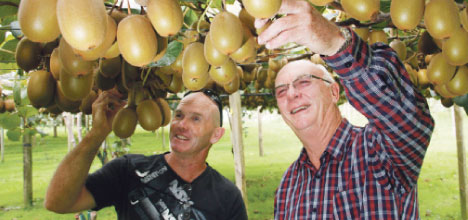
Pahoia orchardist Melvyn Walker and Keith Garnham check some of his Melvyn's healthy G3 crop that has been on a programme of TEPA chelated copper and seaweed fertiliser. Photo by Tracy Hardy.
'It's all I'm using and I believe that it's actually working. I haven't put anything else on it. And I've got a crop on there now, but whether people want to believe it or not is up to them.”
He has used it on all his vines, including the green which had early signs of Psa-V that have since gone.
After holding off against Psa-V his green was infected about nine months ago, a lot later than neighbouring orchards, but Melvyn believes the spray programme is helping him manage the disease. It is difficult for him to directly compare this year's crop to last, but says apart from the lack of water was 'pretty happy with the crop”. After taking out half his canopy to change over G3 Melvin is expecting a Hort 16A crop of 7-8000 trays/ha, compared to his normal crop of 15,000 trays/ha for a full canopy.
'The spray's helping it, I'm not going to say it's going to kill it, but it's definitely helping to suppress it,” says Melvyn, about the foliar fertiliser former Te Puna orchardist Keith Garnham distributes.
Keith, who has imported the spray from Europe for about 10 years, was planning to drop the product just before Psa-V arrived – but changed his mind because of the Italian experience where the only surviving 16A Gold had used it.
'I had some very loyal customers but I didn't think it was worth the little interest,” says Keith, who has struck some resistance from orchardists who had mixed results with TEPA chelated copper in the early years before the best programme was developed.
'There will be some growers out there who say ‘this stuff is snake oil. It didn't work for us'. All I can say is that in the course of time we've been able to work out programmes that seem to be working for the growers I work with when it's matched with adequate nutrition.”
Licensing issues preventing the earlier product from being registered as a pesticide meant it could not be endorsed by KVH. This prompted Keith to market a new product under the brand name Coptyzin which is 95 per cent of the original formulation and offers the same benefits. Copper bactericide Coptyzin is one of three copper sprays KVH's recommends in its autumn and winter spray programme.
Zespri innovation leader Jayson Benge said Coptyzin was being field tested for efficacy against Psa-V and results will be published in May-June if trials are successful.
The Ministry for Primary Industry recently accepted Coptyzin as an approved compound under the ACVM (agricultural compounds and veterinary medicines) regulatory framework giving it a limited label claim for the control of Psa-V. Approval is based on overseas or greenhouse data and is valid for 12 months during which time more efficacy data is to be collected to earn a full label.
Keith says its formulation as a special copper chelate that is absorbed into the plant, rather than just working on the leaf's surface is its key difference. Melvyn believes this is the key, saying when you consider that Psa-V is on the inside of the plant not just the outside you need something that will fight if from inside the plant as well. Along with his spray programme, Melvyn is running a few experiments on his vines, cutting some back to the main leader and leaving others to see what works best to learn what approach is best.
Despite enthusiasm for his spray programme and experiments, he has decided to change over to G3, saying it was all about finding the best way to manage Psa-V.
'The fact that G3 seems to be less susceptible to Psa-V means that my chelated copper will do a better job and make it easier for me, if there was no G3 or new variety I would be going for Hort 16 A again this year.”
Keith says the biggest reward is helping growers: 'When I get an email saying ‘I thought my orchard was stuffed but now it's turned around and I think I've got a future with it' - that's very satisfying”.

0 comments
Leave a Comment
You must be logged in to make a comment.