


Dirt on the soles of just one pair of boots could introduce a deadly kauri disease to the Coromandel which is why a series of public workshops to develop ways of protecting the forests will be held in May.
'Kauri dieback hasn't been found on the Coromandel yet, but it only takes one pair of dirty boots, bike tyres or walking poles to spread the disease, and anyone coming from infected areas such as the Waipoua Forest, Great Barrier Island or the Waitakere Ranges is a potential carrier,” says Kauri 2000 chair Vivienne McLean.
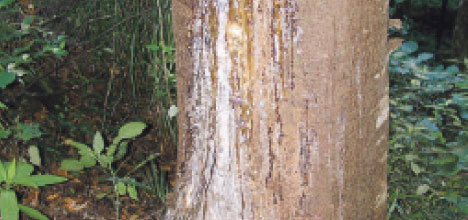
Bleeding lesion – one of the symptoms of kauri dieback disease.
'This is a major environmental issue – and a threat to our tourism-based peninsula economy, which is heavily dependent on our unique environment. No-one will want to come here to walk or run through forests of dead and dying kauri.”
Momentum
Vivienne says public concern for the fate of the kauri is gathering momentum but most of the attention and resources has so far been focused on dieback-infected areas of Northland, Auckland and Great Barrier Island, with little happening to prevent the spread of this devastating disease to kauri forests in the Coromandel Peninsula and the Kaimai Ranges.
Coromandel Peninsula conservation group Kauri 2000 is so concerned about the threat that kauri dieback disease poses to kauri on the peninsula that it is holding a series of free workshops on May 18 and 19 to raise public awareness of the disease and to help communities develop ways of protecting their local forests.
The programme will include presentations on what is known about kauri dieback disease, how to recognise it, what are the risks for the Coromandel Peninsula, tools and techniques for preventing dieback spread, and ways in which locals can work together to help keep it out of their forests.
'The best way to protect our forest ecosystems will be for our communities, marae, landowners, schools, businesses, environmental group,in fact anyone who uses and loves the bush, to work together and come up with specific strategies that work best for their area,” she says.
At present there is no known cure for kauri dieback, a devastating phytophthera that spreads through soil movement. The key messages being promoted by the Kauri Dieback Response Team to prevent the spread of the disease are:
• Always stay on the track and off kauri roots
• Clean your gear – remove every trace of soil before and after forest visits. Clean your shoes, tyres and equipment by scrubbing with hot soapy water.
• Symptoms of kauri dieback may (but not always) include bleeding at the base of the tree, yellowing leaves, thinning canopy, dead branches and sudden death. Diseased trees do not always show all the symptoms, however, and other diseases may show similar effects.
'It's important to be proactive and prepare before the disease is found here – the longer we can keep it out of the Coromandel, the more time we buy for scientists to find solutions. We need to strike a balance so that holidaymakers, tourists, off-road runners and bikers, pig hunters, trampers and the like can still access the bush, but understand what they need to do to protect it.”
Workshops
The workshops are being run with support from the Kauri Dieback Response Team, the Department of Conservation and the Waikato Regional Council.
Dates and venues are as follows:
• 1pm Saturday, May 18 - Grahamstown Community Centre, Pollen St, Thames.
• 1pm Sunday, May 19 - Coromandel Area School Hall, Woollams Ave, Coromandel.
• 6pm Sunday, May 19 - Whitianga Town Hall, Monk St, Whitianga.
Everyone is welcome to attend any of these free workshops. To help with estimation of numbers, please register your interest with the Kauri 2000 Trust by Wednesday, May 15 by phoning 07 866 0468 or email: [email protected]. For more information visit:
www.kauri2000.co.nz or www.kauridieback.co.nz

0 comments
Leave a Comment
You must be logged in to make a comment.