


In the 1980s sweet persimmons held the promise of a lucrative new export crop enthusiastically embraced by many New Zealand growers but the attractive orange fruit proved hard to grow to export standards.
Although exports reached about 2500 tonne in 2002, in recent years volumes have dropped to about 1280 tonne, produced by 40 growers who pack their fruit through 16 pack houses.
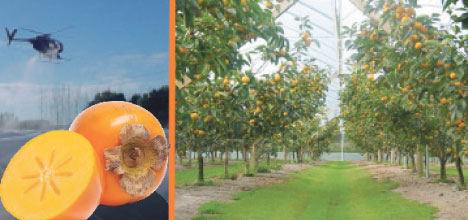
Persimmons grow under plastic at Holyoak Orchard owned by Geoff and Leigh Peach.
Among the most successful is Geoff Peach of Matangi in the Waikato, who for the last 18 years has been growing persimmon under cover, as well as outdoors.
When first starting out, the former market gardener and sheep farmer identified the potential of persimmons, and saw the difficulty others could have in producing export quality fruit, as an opportunity.
Geoff's son, Dan Peach, was managing a blueberry block after graduating from Lincoln University when a blueberry and persimmon orchard became available for lease, so they went into partnership. This partnership lasted a few years until Dan ventured out on his own with blueberries and Geoff continued with persimmons. Both grow fruit under cover as part of their operation.
Fruit is grown under cover with the intention of producing early season fruit. Geoff says despite the cost of building the support structure, installing and replacing plastic when required, that decision has more than paid for itself in improved fruit quality and export earnings.
'We bought trees from an orchard which was up for sale because we knew the variety was an early one, and planted the trees in bags.”
Today 0.6 ha of persimmons grow under plastic at Holyoak Orchard owned by Geoff and Leigh Peach, producing consistently early, sweet-tasting, export quality fruit. However, growing under plastic isn't easy, says Geoff. 'The plastic lasts about six years and needs to be cleaned regularly – by helicopter. 'The orchard is at Matangi, and Matangi in Maori means wind, so wind damage can be a problem, sometimes as often as 10 times a year.
'Humidity can also be a problem, and insect and fungal attacks are 10 times as bad as on trees grown outside. Leaf roller, mealy bugs, mites and thrips are the biggest insect pests. We have pulled back our thresholds for spraying for pests and diseases but the advantage of growing under cover is that I can spray when I need to because there is no risk of spray drift affecting neighbours due to no wind under the cover.”
The plastic which covers the Holyoak persimmons is impermeable so keeps off rain but it also means Geoff can control exactly the amount of moisture the trees receive. The trees are also protected from frosts.
Although the light is diffused, Geoff says fruit colours nicely, with high brix levels early in the season. However, as temperatures can be as much as 10 degrees higher inside than out, keeping the trees cool is an issue which Geoff controls with ventilation.
Flower thinning is an important management tool and blossoms are pollinated by bumblebees, brought from five small hives, introduced in spring. 'It's often too hot inside for honey bees to work well but bumble bees will work really hard, ‘sonicating' or vibrating each flower so hard it's pollinated in just one visit,” he says.
'One of the benefits of growing under cover is that your workers can come any day because weather is not an issue, and you can pick when you like.”
Because few others were growing persimmon under cover, Geoff has had to develop management techniques from experience and his own experiments and he's still learning.
Sweet persimmons:
Export plantings are widely spread through northern New Zealand. The main areas are: Gisborne (about 28 per cent by area), then North and South Auckland (20 per cent each). Other growing regions include Northland, South Auckland, Waikato, Bay of Plenty and the Hawkes Bay.
The major export markets for New Zealand persimmons are, in decreasing order of volumes: Thailand; Australia; Malaysia; Singapore; Europe/ UK; Hong Kong; Canada.
The main variety exported from New Zealand is Fuyu. This is a non-astringent variety which means that it can be eaten while it is still crisp.

0 comments
Leave a Comment
You must be logged in to make a comment.