


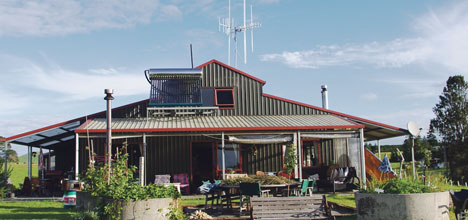
Karen Robinson doesn't waste any opportunity in her quest for sustainability, so it's not surprising she uses the dashboard of her parked vehicle to help dehydrate fruit and vegetables grown on the Oropi property she and husband Will call the Solar Barn.
'It gets so hot inside the ute I figured I might as well use it for dehydrating, so if I'm going to be in town with the vehicle parked up and windows closed for a while, I arrange the trays on the dash and let the sun do its work,” laughs Karen.
Using free solar energy that way is just one example of the innovative thinking Will and Karen apply to their quest to live 100 per cent sustainably.
The couple began their ambitious project on 5ha of land in Hereford Road in 2005, first building the ‘barn' which is both their home, the source of much of their energy and all their water.
Rainwater from the large, two-storeyed house is captured and stored in tanks. A solar panel on the roof uses sunlight to heat domestic hot water through the summer and is supplemented by a Marshall Hot Water solid fuel heater in winter. The barn is very well insulated and its concrete floor absorbs daytime warmth, releasing it at night in an effective passive solar heating system.
Electricity is generated by the large array of solar panels Will has constructed to follow the sun, and a wind turbine he also built. A meter in the home records how much power is being used and energy-efficient fridges and a freezer means at times the amount drops away to nothing.
There's an outside toilet, but it's not a long-drop. Instead, inside a spacious room is a Bio-Loo composting toilet which converts what Will calls 'number one and number twos” into a valuable fertiliser which is returned to the land.
However, Will is working on a domestic sized bio-digester to extract methane gas to fuel the cooking hobs in the kitchen.
The home's grey water from washing and showers is directed to a branched drain distribution system which irrigates fruit trees.
The couple now have a cow, called Betsy, which is milked daily to provide A2 milk, which Will and Karen say is better for the digestive system than milk from cows which produce both A2 and A1 milk.
Soft cheeses, butter and yoghurt are made from the milk and each day Karen bakes bread, using a ‘starter' she feeds to constantly provide the yeast required.
'Bread made this way and the yoghurt are examples of pre-digested foods, which I believe are better for our system and help promote good health,” says Karen.
While Will's the inventor, (he's also converted their cars to run on waste vegetable oil), the Mr Fix-it man, stockman (caring for cows, sheep and goats they graze) beekeeper and milker, Karen grows all the organic fruit, herbs and vegetables.
'It's tremendously satisfying to sit down to a meal and know that virtually everything on your plate you have grown and produced yourself.”
Karen is implementing a no-dig form of gardening, and even used a fleece from one of their sheep to spread on the garden, topping it with grass clippings, to form a weed-suppressing,
water-retaining mulch. Karen is also a talented seamstress, designing and making clothes, bags, kitchen accessories, as well as altering clothes for clients.
Her hands are seldom idle and she makes crochet rugs as well.
The Solar Barn has become a popular destination for Willing Workers on Organic Farms –known as Woofers. The most recent are Andrew and Alise Miller from Kansas and Anne Keen from Colorado.
The trio, who were inspired by what Karen and Will have achieved, and still dream of achieving, helped the couple prepare for the Sustainable Backyard workshops and seminars they hosted during March. Andrew and Alise plan to begin an organic fresh food store and Anne's dream is to build and operated a fully sustainable retirement village. Will reckons it can be done – and has suggested a bio-digester to turn human waste into fuel for cooking.
Two years after they embarked on their ambitious project, Karen was diagnosed with cancer.
'I was so scared. My whole world was rocked to the core. My chance of a good outcome was 70 per cent, so I had to work hard for this.
'The cancer could not be cut out. I chose to do both complimentary and conventional treatment. I had chemo and radiotherapy – what a journey. I have been in remission for two years now and have a new lease on life. There has been an amazing shift within me.”
Coping with and recovering from the illness has further reinforced Will and Karen's commitment to healthy eating and lifestyle and it's something they want to share with others – which they do through regular workshops and seminars throughout the years.
'There is so much people living in town can do, from growing a few vegetables in pots if they don't have much room, to making their own yoghurt, or having a big vegetable garden and even raising chickens in areas where that's allowed,” says Karen.
To find out more about the Solar Barn, its seminars and workshops visit the website www.thesolarbarn.com

0 comments
Leave a Comment
You must be logged in to make a comment.