


The angry buzz from the pile of clean washing was warning enough to be careful with the folding – I'm allergic to bee stings.
However, it took a while to work through the layers and find a large bee of a kind I'd never seen before. Once released, he headed straight for the window and we caught him in a jar for a better look.
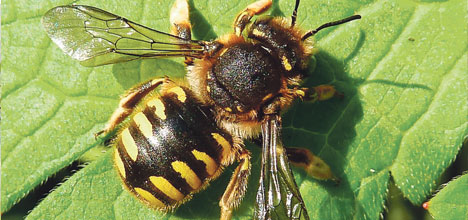
Wool carder bee soaking up sun.
About the size and shape of a bumble bee, the insect had distinctive black and yellow markings on its abdomen so I photographed it and sent the image to the Ministry for Primary Industries, where it was identified as a wool carder bee – A. manicatum.
So I hadn't discovered some new unwanted organism which had just breached bio-security, but these bees haven't been in this country for long either. They were first identified in Nelson in 2006, followed by several records in Auckland in 2007-8. It is native to Europe, northern Africa and Asia but is also found in the USA, Canada and Brazil and gets its name from the habit of the females of scraping the hair from leaves of plants like lambs ear, to make linings for their nests.
They are solitary bees and the males are very territorial, defending floral resources from other males, other bees and flower-visiting insects, and mating with females that arrive there. Males have five sharp spines on the abdomen that can damage or even kill intruding insects.
The female can occasionally be seen ‘carding' fibres from plants. The bee visits a variety of different plant species but has a preference for purple or blue flowers from the mint family (Lamiaceae), such as rosemary.
MPI says that at the time of its first detection here it was considered unlikely that A. manicatum would have any noticeable or significant impact to New Zealand's apicultural industry. Since then, no impacts have been observed or reported. Nowhere overseas are wool carder bees considered to be pests of honey bees. The solitary nature of this species suggests that it will not form large, dense or problem populations that could cause issues. Other bees are seldom injured by the wool carder bee's aggressive behaviour and they usually just fly away after an attack, the ministry says.
There may be some competition with other introduced species for nesting holes.

0 comments
Leave a Comment
You must be logged in to make a comment.