


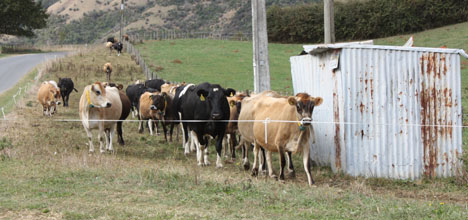
The drought and lower milk prices mean North Island dairy farmers are collectively $114 million down on earning for February reports DairyNZ.
Dairy NZ senior economist Matthew Newman estimates across the whole of the North Island for February this year North Island farmers will receive $114 million less milk revenue than February 2012. The drought counts for a reduction of $64 million and lower milk prices for $50 million.
'This is based on a prediction of 15 per cent lower milk collected this year compared to last year for the month of February across the North Island,” he says.
The comments come as Minister for Primary Industries Nathan Guy announced a state of drought in Northland, saying an official declaration for other areas is likely to follow.
'This is recognition that we are now beyond what is a normal dry summer, and into an extreme climatic event. The entire North Island is extremely dry, but Northland is one of the worst-hit areas.
'This drought decision has been made after receiving advice from the Ministry for Primary Industries, including soil moisture data from NIWA, and in consultation with the local community. It applies to the area north of the Auckland Harbour Bridge.”
Farmers in Northland will have $13 million less income from milk produced in the month of February 2013 compared to the same month a year ago, he says.
About $8 million of this is from reduced milk production, while the remainder is from lower milk prices.
'Northland milk production for the month of February 2013 is about 20 per cent lower than February 2012. In the wider Waikato, production for the same month is about 15 per cent down,” he says.
Bay of Plenty Federated Farmers president John Scrimgeour says while a drought hasn't yet been declared in the Bay of Plenty or Waikato, a watching brief is being kept on conditions.
'In the Bay I understand the worst affected areas are south of Rotorua but it remains to be seen how things unfold in the next couple of weeks.”
Many dairy farmers are culling cows from their herds.
'The works are going full noise but by and large there is not a back log so far.”
While it appeared few farmers in this region had dried their cows off, most were milking once a day, or every 16 hours in the hope of retaining some milk production until the rains come.
'The long term forecast indicates we might get rain early in March but we can't rely on that.
'Farmers are feeding out palm kernel and other supplements but prices are rising in response to demand.”
John says rain over Christmas and early January has helped the region get through the weeks of fine weather and maize silage will soon become available for supplementary feed. 'However, the dry weather has affected that too and it may not be in the quality or quantity people are hoping for.”
'The economic effects of that drop will ripple through rural communities. If it stays dry for another three or four weeks, and herds have to dry off early, then the medium term impacts will be a lot more dramatic.”
Concerns now are for the welfare of farmers as well as their stock with the minister saying the declaration of a medium-scale event means that extra Government funding will now be available to coordinate support through local organisations like the Rural Support Trusts.
'In extreme cases there will also be rural assistance payments available to farmers in severe hardship. Support is also available from Government agencies in all regions, even without a drought declaration.
'Farmers should contact IRD if they need help or flexibility with making tax payments, and standard assistance is available from the Ministry of Social Development.
Neil Trebilco of New Zealand Kiwifruit Growers Inc says the hot dry summer has slowed the activity of the vine disease Psa-V but growers who don't have irrigation will be hoping for rain to help size their fruit in time for harvest.
'Orchards in areas where spoils are deep and vine roots can penetrate are not too badly affected but orchards with shallow soils and without the ability to irrigate will be feeling the lack of water.”
Neil says even if rain comes soon it is likely fruit size will be down this season on average, because of the hot dry summer.
James Parsons, Beef +Lamb director for the Northern North Island says dry stock farmers are feeling the effects of the dry weather.
'It is hard to get stock killed (in Northland) as a lot of works are flat out.” As a consequence the prices paid to farmers had dropped.
'The store market is also flat with fewer buyers around because people don't have the grass to farm animals on. It's also going to be hard on farmers selling through the up-coming weaner fairs, if it doesn't rain soon.”
Farmers will have put rams out with the ewes or be planning to soon, but the sheep are not putting on weight as they should at this time because of the dry conditions.
'Another issue for farmers is the availability of water for stock as animals need to drink a lot in these conditions. However, we are now into autumn and then usually means rain,” says James who is hoping for a long spell of gentle rain to enable the soil to take up the moisture it needs.

0 comments
Leave a Comment
You must be logged in to make a comment.