


Scientists have developed new biological control agents that show promise in the fight against Psa-V - but are not claiming them as a cure.
Dr Phil Elmer of Plant and Food told yesterday's Psa symposium in Tauranga that a preparation made from a combination of an elicitor, a fungus and yeast has shown pleasing in controlling the bacterial disease in results in laboratory trials.
Dr Phil Elmer of Plant and Food says scientists have found biological control agents which may help in the fight against Psa-V.
Orchard trials of the new agent are set to begin this spring.
Kiwifruit Vine Health CEO Barry O'Neil says despite the promise no one should think it is the final answer to Psa.
He says there will be no one answer to managing Psa, although this new product may be part of wider management practises that could bring it under control.
Phil and Barry were two of many speakers from New Zealand and Italy who addressed the 164 delegates at the New Zealand Plant Protection Society symposium at Mount Maunganui to outline what has been learned about the disease since its discovery in New Zealand in 2010.
Phil says preparations he and other scientists are working on combined Actigard, a plant activator (or elicitor) already licensed for use on kiwifruit for Psa control, with the soil fungus trichoderma and yeasts selected from more than 300 yeasts which proved to have some effect on the Psa bacteria.
The combination of the three, in products called YM2 and YM1proved more effective than any one on their own, he said.
In the first field trial Hayward plants in pots had Actigard and yeast mixes applied 10 and two days before they were inoculated with Psa in December and then subjected to 48 hours of overhead irrigation.
After 25 days the plants were assessed. Untreated plants had leaves which were nearly 70 per cent necrotic (dead) while those treated with two different biological control formulations had less than 5 per cent of necrosis in the leaves.
 Italian scientist Giorgio Balestra is among scientists working on a biological control agent to protect kiwifruit flowers and pollen from Psa infection.
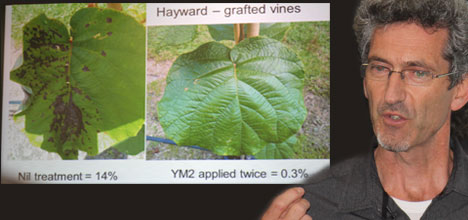
YM2 was applied twice to leaves on Hayward grafted vines at Te Puke and the results showed a treated leaf with just 0.3 per cent spotting (Psa infection) while an untreated leaf showed 14 per cent infection.
Phil says additional assays have identified tricoderma root endophyte mixtures, which significantly supressed Psa expression, with 100 per cent survival compared with only 25 to 50 per cent survival in Psa inoculated controls.
It also appeared just one application of the tricoderma mix may be all that is required.
Earlier, Italian scientist Giorgio Balestra told the symposium of trial work with a biological control agent, which was showing some success in protecting kiwifruit flowers and pollen which is important because growers are limited in the sprays they can use during flowering and pollination.
However, he said research also showed Psa-V could infiltrate every part of a kiwifruit vine, including the roots and it can survive in the soil.
In the case of an orchard with just a few infected vines, Giorgio said the best solution was to remove the entire plant, including roots, disinfect the soil and not grow kiwifruit in that position again for at least a year.
However, he acknowledged that was not a practical or economically viable solution for growers with large numbers of infected vines.

0 comments
Leave a Comment
You must be logged in to make a comment.