


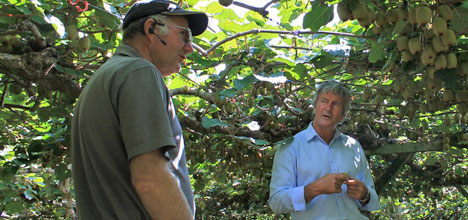
New Zealand has a non-interventionist, market-driven Government reluctant to take action over bio-security issues such as Psa-V, says Labour Primary Industries spokesperson Damien O'Connor.
Damien was in the Bay of Plenty yesterday visiting orchards hard hit by the bacterial disease Psa-V, at the invitation of growers keen to inform him of what is happening to the industry.
Te Puke grower Alan Beaver talkks with Labour Primary Industries spokesperson Damien O'Connor about the impacts on Psa-V on his orchard.
New Zealand could not afford another bio-security breach such as the one that let Psa into the country, he said.
Cut backs in bio-security funding were not the issue – it was where the money was spent and understanding the risks which mattered.
'You can manage risk if the right systems are in place.”
Damien says he has read the Sapere review, called for by New Zealand Kiwifruit Growers Incorporated and commissioned by the Ministry of Primary Industries to look into how the disease got to New Zealand in 2010.
The report found imported kiwifruit flower parts and pollen may have been one way it arrived, but the industry was largely unaware pollen was being imported.
He says in Australia a more pragmatic approach has stopped imports of pollen, believed to be the vector for the disease in New Zealand.
During Damien's visit yesterday Te Matai Road orchardist Alan Beaver walked Damien through the Hayward green orchard he and his family own, which is carrying about half the fruit numbers it should due to Psa.
'My brother John and I have done much of the work on the orchard ourselves because there's little money to pay anyone,” says Alan.
'The sad fact is that if we were making money we would be employing staff, and a lot of other growers are in the same position,” Alan said.
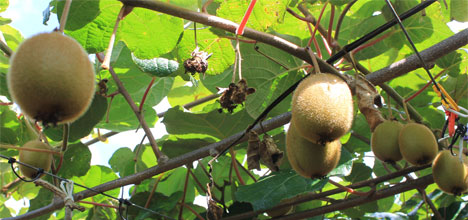 Dead flowers and fruit that failed to form properly mean the crop yield had been almost halved on this Te Puke orchard due to Psa-V.
Alan said while growers were not looking for Government hand-outs, some assistance, even in the form of loans, to enable them to do the work needed to get their orchards back into full production would be money well spent on an industry which was once an important export earner.
'It costs money even to cut out diseased vines, let alone everything else which needs doing. A lot of growers are now doing just the bear minimum on their orchards.”
Grower Rob Thode, who also took Damien on an orchard tour, agreed.
'The kiwifruit industry used to employ more than 20,000 people but that's likely to drop to 10,000 this season.
'It will recover but in the meantime growers are facing little or no income, but all the costs of trying to grow a crop.”
Damien said the Government had done the right thing by coming up with $25 million when Psa was first discovered but on-going support for the industry was needed and would provide employment for local people and keep skilled workers in the region.
Damien also visited a Hayward green orchard in Bell Road, which has been very badly affected by Psa, and orchards in Te Matai Rd, one where the new variety G3, believed to be more tolerant of the disease, is struggling to survive and another where Hayward Green and Enza Red varieties are performing quite well.
He is due to meet with Zespri officials in Wellington later this week.

1 comment
Is visiting PSA orchards sensible?
Posted on 12-02-2013 10:39 | By Phailed
Can the disease be spread by people accidentally transporting infected matter from one orchard to another? Can answer this?
Leave a Comment
You must be logged in to make a comment.