


A charitable organisation supplying wild venison to foodbanks around the country is encouraging hunters to get on board.
Formed in May 2025, the Wild Game Recovery Trust (WGRT) now supports 120 foodbanks nationwide through its Game Changer NZ programme.
General manager Sarah Gagliardi said donors choose the foodbank they want to support, with their donation funding that foodbank.
Hunters donate the animals, butchers prepare the meat, and the foodbank distributes it to people who need it.
“Every $120 donated helps turn one wild deer into quality meat for your chosen food bank.”
Gagliardi said the Game ChangerNZ programme focuses on deer donation.
“We have individual hunters, hunting groups and New Zealand Deerstalkers Association branches – a total mix.
She said the WGRT “connects all the dots”, co-ordinates from hunter to food bank and pays processing costs across the country.
Current New Zealand-wide total meat distribution is 4487kg, which is 35,896 meals (based on a universal mince meal serving size of 125 grams).
Regions include Bay of Plenty (Katikati to Rotorua) and Waikato (Coromandel to Turangi).

Danielle Connole (left) and Rob Cameron from Cameron Harrison Butchery, with Wild Game Recovery Trust representatives Sarah Gagliardi, Sandra Alfeld and Wayne Langford at the New Zealand Deerstalkers Association Hunting & Wildlife Expo in July.
Gagliardi said food banks have rallied around the programme, raising funds to cover processing costs through Game Changer NZ.
“As a result, processing funding isn’t the barrier – nearly all food banks have funds in place for continued processing and are simply waiting for hunters to harvest and donate animals so they can get meat to the people who need it.”
She said food banks recognise the important role hunters play and are incredibly grateful for their contribution.
“They think it’s amazing that we have access to such a valuable source of wild protein and see hunters as a vital link in getting that meat to the people who need it.”
Hunters wanted
Hunters can sign up to become a Game Changer NZ hunter.
“We utilise GAC’s ‘Hunt and Share’ platform, which is where hunters log their animal at the point of donation/harvest,” Gagliardi said.
Hunters complete a three-minute knowledge check when they sign up to be a Game Changer NZ hunter, via the GCNZ Hunt and Share platform.
“Our big CTA (call to action) is to get hunters keen on and amongst this work and be part of something that’s making serious headway in food security, while contributing to wild animal management.”

Wild Game Recovery Trust founder Wayne Langford at the WGRT/Game Changer NZ stall at the New Zealand Deerstalkers Association Hunting & Wildlife Expo in July.
Gagliardi said each time $120 is raised, a registered WGRT hunter gets the green light to harvest a wild deer for that specific foodbank.
The animal is delivered to an approved local butcher, professionally processed and packaged into 500g-1kg venison mince portions.
The foodbank collects the packaged venison directly from the butcher and distributes it within their community. One deer = 200 meals.
Gagliardi said the WGRT exists to tackle two pressing realities head-on: the unchecked rise of wild animal populations across New Zealand, and the growing strain of food insecurity facing families nationwide.
“Hunters are already out there doing what they love.”
She said the trust’s role is to make sure that effort goes even further – backing hunters to manage wild animal numbers while getting quality protein into foodbanks.
Community impact
“This is hunting turned into community impact,” Gagliardi said.
“Hunters are skilled and passionate about what they do.
“This trust is about backing them with the funding, resources, and infrastructure to turn that skill into something bigger — reducing wild animal pressure on the environment and putting food on the table for families.”
Gagliardi said wild animal numbers have nearly doubled across New Zealand in the past decade, causing significant destruction to conservation land, forestry and farmland.
“The ecological cost is huge.
“Overabundant wild animals are changing the composition of native vegetation, preventing forest regeneration and reducing the food sources and habitats that native species depend on.

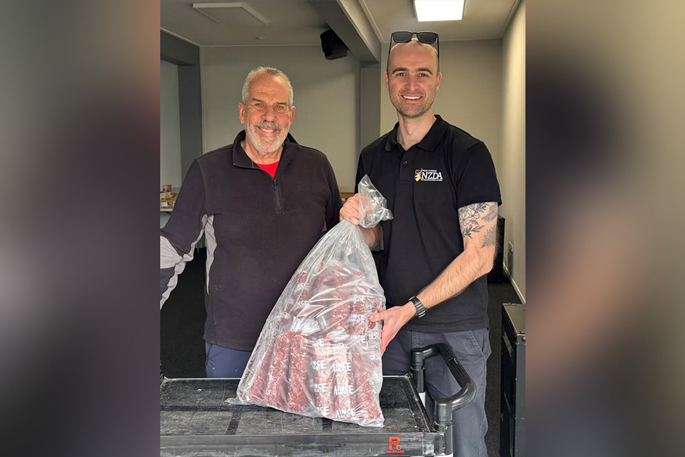
Deer being dropped off by Auckland New Zealand Deerstalkers Association for processing into venison mince packs for Auckland food banks.
“Wild animals also pose huge challenges for farmers, causing an estimated $213 million in damage to farmland every year.
“Currently, the problem isn’t being managed well enough — and that’s where harnessing the skills of hunters becomes critical to keeping wild animal numbers under control.”
Gagliardi said at the same time, nearly 18% of households are experiencing severe food insecurity.
“Protein is one of the hardest items for food banks to source and, as the cost of living continues to rise, more and more families are going without it.”

0 comments
Leave a Comment
You must be logged in to make a comment.