


Tauranga City Council has approved a further $3.5 million for Mauao’s landslide recovery, taking forecast operational costs to $10.5m.
Six holidaymakers died when a section of Mauao collapsed into Mount Maunganui Beachside Holiday Park, owned by Tauranga City Council, about 9.30am on January 22 after record rain.
The council had spent almost $6.7m by the end of September after previously approving $7m from its risk reserve for the landslide response, recovery and associated reviews.
The $3.5m requested by the recovery team would include $1m for geotechnical monitoring, reporting and advice, $700,000 for security and $600,000 for recovery staff costs, with further funding forecast for reviews and associated legal support.

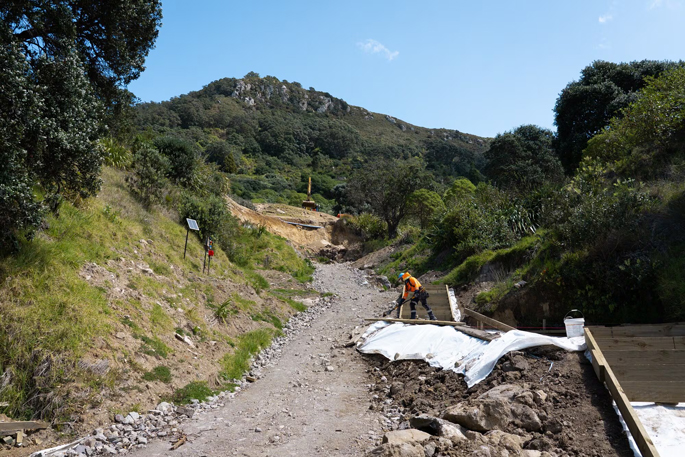
Recovery manager Charlie Rahiri said the stairs on the Waikorire Track were completely wiped out. Photo / Tauranga City Council
In a tense debate on Tuesday, councillors were uneasy about approving such a large amount without a detailed spending plan, particularly given forecast expenditure on legal support, geotechnical advice and security.
There was also concern about borrowing additional money, and councillors debated whether the council should instead find savings elsewhere.
Deputy mayor and Mount Maunganui councillor Jen Scoular said she could not approve $3.5m without a detailed plan.

Mount Maunganui ward councillor Jen Scoular. Photo / Kelly O'Hara
“We’ve been asked for $3.5 million for unbudgeted costs without more than three sentences on what it’s going to be spent on.”
The $700,000 forecast for security costs was expected to fall after the number of wardens at Mauao was reduced from seven to two.
Councillors requested an updated security cost forecast as part of a detailed budget to be provided within seven days.
A staff report authorised by recovery manager Charlie Rahiri outlined three possible avenues for the funding.
The council could:
- Approve $3.5m of loan-funded expenditure.
- Approve $3.5m of expenditure with an expectation that offsetting savings were found across the organisation.
- Or not approve any funding and halt all work across the recovery and review work streams.
Rahiri said the $3.5m was “better to have and not need”.
“It’s not anticipated … that we will try to exhaust that entire amount of money.”
Mayor Mahe Drysdale said: “When we spend money, we want to imagine it’s our own money”.
Te Papa councillor Rod Taylor supported making the additional funding available, saying the recovery was too important to delay while the council looked for further savings elsewhere.

Te Papa ward councillor Rod Taylor. Photo / Kelly O'Hara
“I think we’ve got certainty that we’re getting this fixed. The community expects that.
“This is just too big an issue to be monkeying around with and waiting to get some more blood out of a stone that we’ve squeezed so many times this year.”
Debt servicing costs for the additional $3.5m would be about $200,000 a year.
The report warned that finding the $3.5m from elsewhere in council budgets would put additional pressure on the organisation, which was already working towards existing savings targets.
The council report said Mauao would not reopen if the recovery works were halted, resulting in “adverse impacts” on the community, tourism and local businesses.
The council unanimously approved the $3.5m, with staff to first seek savings elsewhere in its budgets before resorting to loan funding if required.
Recovery progress
Rahiri said remediation work was progressing “expeditiously” and the team was grateful the good weather allowed work on some of the more difficult areas.

Recovery manager Charlie Rahiri. Photo / Tauranga City Council
He said they were advised last week that tension cracks had appeared, which they were watching cautiously.
Māori wardens on site were reduced from seven to two, and Rahiri said he was investigating opportunities to involve the public in security.
The report said the recovery efforts were moving from assessment and planning into delivery.
The slip on the Waikorire Track (the summit track with the stairs) would be the next significant area of focus, alongside continued work on Te Ara Tūtanga (the base track) and the wider oceanside area.
In a video posted on the council’s Facebook page, Rahiri said the stone steps on the Waikorire Track remained intact but the wooden steps were destroyed.
He said the Waikorire Track had been one of the most intense to remediate.
“We’re rebuilding those and we’re trying our hardest to get safe access back to Mauao.”
He said archaeology of Mauao’s 600-year history of human settlement had been uncovered during the work.
“We’re seeing, through this remediation, where our people used to live and what they used to do in those areas.”
The report said discussions on reopening Mauao during summer were underway.
“Reopening will be evidence-led and may occur in stages,” it said.
A viability assessment for the future of the Mount Maunganui Beachside Holiday Park has begun and would include community consultation.
How the funds have been spent
By September 30, the council had spent:
- $871,645 on its initial response.
- $3.54m on ongoing Mauao recovery.
- $2.27m on reviews and legal support.
This totalled $6.68m in operational expenditure, leaving $318,120 of the $7m the council had previously approved from its risk reserve for the landslide response, recovery and associated work.
The ongoing recovery spend included $1.66m on professional and technical advice, $892,683 on security, $522,820 on physical works and equipment and $360,874 on recovery staff.
Ayla Yeoman is a Local Democracy Reporting journalist based in Tauranga. She holds a Bachelor of Arts majoring in communications, politics and international relations from the University of Auckland, and has been a journalist since 2023.
LDR is local body journalism co-funded by RNZ and NZ On Air.


0 comments
Leave a Comment
You must be logged in to make a comment.