


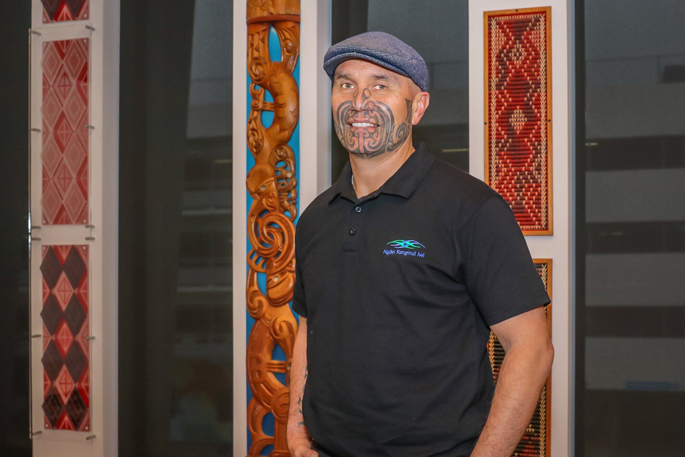
The best time to start speaking te reo Māori is now, says University of Waikato academic Associate Professor Ngairo Eruera.
“There’s no good time. There is only now. You just practise what you can,” said Eruera, who teaches and researches Māori language and has seen a significant increase in the visibility of te reo Māori since returning to Tauranga eight years ago.
His message is fitting during Te Wiki o Te Reo Māori – Māori Language Week, which encourages New Zealanders to bring more te reo Māori into their everyday lives.
For Eruera, the language’s distinctiveness comes from its deep connection to Aotearoa.
Although Māori speakers now live around the world, the language has its roots here, making it a taonga – a treasure – for everyone living in Aotearoa.
“You don’t have to be Māori or Pākehā or any other background or ethnic persuasion or cultural persuasion to appreciate the effect,” he said.
“If you live here in Aotearoa, it’s your taonga as well, your treasure as well.”
Deeply connected
Eruera said people can be deeply connected to Māori culture without speaking the language, whereas learning te reo Māori provides “a window into deeper understanding” and another way to express that insight into the culture.
He’d seen that connection become increasingly noticeable around Tauranga.
When he returned to the city after years living and working in Waikato, the Māori language was mostly heard at distinctly Māori occasions such as tangihanga, marae gatherings and formal hui.
Now he regularly encountered former students and others speaking Māori in everyday community settings.
“There’s more impetus behind those that can speak Māori to actually speak Māori to others,” he said.
Tauranga Moana had its own particular flavour of te reo Māori, partly because of its connections to several waka traditions.
Eruera identifies Mātaatua, Tākitimu, Te Arawa, Kurahaupō and Tainui influences, creating a linguistic landscape where different language traditions overlap.
“The language here in Tauranga Moana is a mixture of the best parts of the language,” he said cheekily.
Tirikawa
He described regional differences as more like accents than separate dialects, with one body of te reo Māori understood across the country.
But local environments and histories influence how people express themselves.
“Those that are inland, who traditionally have lived in heavily forested areas…their language will reflect that,” he said.
“Here in Tauranga Moana, we live mostly on the coast, so we use different things that are of the environment to express ourselves.”
One local example is ‘kia Tirikawa te tū’, a phrase Eruera said local tamariki and rangatahi were learning as an encouragement to be resolute like Tirikawa, or North Rock, off Mount Maunganui.
The rock may be covered by waves and tidal surges, but it remains.
“You’ll get challenges in life, but if you’re like Tirikawa, those challenges wash off you, over time,” he said.

Associate Professor Ngairo Eruera at Waikato University's Tauranga campus in Durham St. Photo / Kelly O’Hara
For many Bay residents, bringing more te reo Māori into everyday life may not require starting from scratch.
Words such as mahi, whānau, kia ora, nau mai, haere mai and tēnā koe were already familiar to many New Zealanders.
At the University of Waikato’s Tauranga campus, Eruera enjoys hearing students and colleagues – Māori and non-Māori – practising words they know.
“Sometimes inadvertently they whip out a ‘kia ora’ or ‘mōrena’ or something like that, and it’s cool,” he said.
Pronunciation
He recommended pronunciation as a good place for beginners to start, particularly with Māori names for people and places. Online dictionaries with audio recordings can help learners practise.
Seeing children grow up speaking Māori gave Eruera confidence about the future of te reo Māori.
“I look at our tamariki. They give me hope. There is a commitment to see the language not just survive but thrive.”
His advice to anyone wanting to play a part was simple: use it. “You don’t wait for occasions; you just use it every day”.

0 comments
Leave a Comment
You must be logged in to make a comment.