


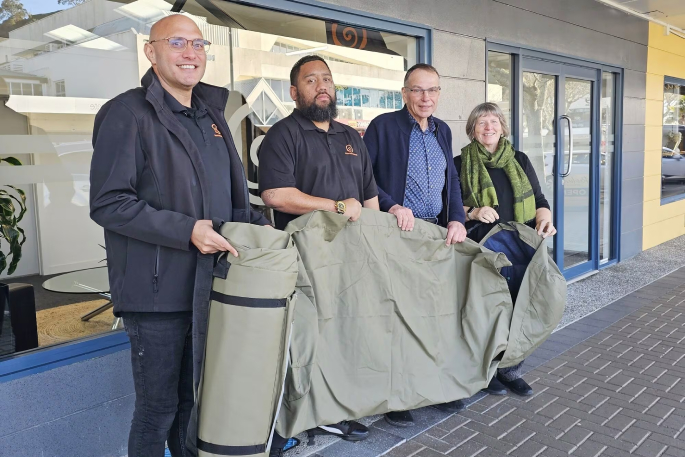
People sleeping rough in Whakatāne have been given extra protection from the elements over the past month, thanks to collaboration between Whakatāne District Council and charitable organisations.
A dozen Shelterbags – large, waterproof sleeping bags with built-in ground sheets and internal pockets – have been distributed by Waiariki Whanau Mentoring and the council over the recent cold snap, when night-time temperatures in Whakatāne dropped as low as -3C.
The Shelterbags were introduced throughout New Zealand this winter through a Rotary New Zealand initiative.
The South African-made bags have been deployed internationally to people made homeless through poverty, conflict or natural disaster.

Several people living rough have taken shelter outside the empty former iSite building, in tents distributed by an anonymous charitable donor. Photo / Diane McCarthy
The bags cost $150 each and more than 1000 were imported by New Zealand Rotary Clubs this year for distribution.
Rotary Whakatāne president John van Boheemen said Rotary had been concerned about the number of rough sleepers around the country and wanted to do something practical to help them.
“Two Taranaki clubs brought in 50 bags the previous year that they distributed around the Taranaki area. They found that it worked really well, and this year asked for Rotary support right throughout the country to bring in a container load.”
Rotary donated six Shelterbags to Waiariki Whanau Mentoring, while the council had been able to attract some external funding to match that donation 50-50, through a private philanthropist.
Whakatāne District Council senior community development adviser Karen Summerhays said the council had not put any ratepayer money toward the Shelterbags but had brokered relationships between Rotary and people providing help to rough sleepers at a grassroots level.

A single-person tent was erected on the stopbank near Kakahoroa Drive recently. Photo / Diane McCarthy
“Some [council] staff members also bought a couple each out of their own pockets.
“From our point of view, it’s about connecting people with projects with the appropriate community partner.”
Council staff distributed one Shelterbag and Waiariki Whanau Mentoring distributed 11 more to people sleeping rough.
Trent Taitapanui, who holds the role of Te Wai Aio Whakamahereora at Waiariki Whanau Mentoring, said the Shelterbags had been well received.
“They love it. It keeps them out of the rain, and they can just roll them up and put them over their shoulder or stash it somewhere.”
He said there had been some initial shyness about accepting them.
“It’s just connecting with them, really. A lot of them were afraid. They get things stolen and they didn’t want to waste it.”
Summerhays said Whakatāne had been “on the radar” for Government funding since the council had started engaging with the Ministry of Housing and Urban Development (now Ministry for Cities, Environment, Regions and Transport) about homelessness in the district.
“Prior to the council engaging with HUD and sending them reports about the homelessness situation, the regions weren’t really getting looked at, it was always the cities.
“Now we are definitely on the radar, and we are asked every time there’s an Insight Report for our numbers.”
Waiariki Whanau Mentoring rangatira Waata Heathcote said a recent round of Government funding had covered a salary for Taitapanui’s fulltime position, a role he describes as “pivotal”.
“Trent is the main connector for the whole community. He’s been doing this for years, but he was just doing it for free; he and his wife.”
Heathcote said the organisation’s focus for next winter was to get some sort of permanent shelter for homeless people.
“We know that homelessness is not going to go away for at least the next couple of years.
He said around 10 to 15% of the homeless community didn’t want to be in a home.
“Some of them prefer to live in the elements, so our focus over the next 10 months is to get them under a roof in some way, fashion or form.
“That’s going to be a big piece of mahi for us.”
Summerhays said that while housing was a solution for some, there was a certain number of the homeless that, for a variety of reasons, it would not help.
“Those who cannot sustain a tenancy will always need supported living, through mental health issues, or literacy issues.”
For some, a home was a place to be feared because of trauma in their early lives.
“Bad things have happened to them in four walls,” said Summerhays. “That’s why they don’t want to be in a home.”
Some ended up on the street after being released from prison or from hospitals with “no fixed abode” or because they had “aged out” of foster care.
Heathcote described many people as “living in silent crisis”.
“The majority of those who are living rough, in fact, marginalised communities in their entirety, are often living in chronic or acute distress.
“A lot of it’s silent. They won’t show the symptoms. It will come out when they are triggered.”
LDR is local body journalism co-funded by RNZ and NZ On Air.


0 comments
Leave a Comment
You must be logged in to make a comment.