


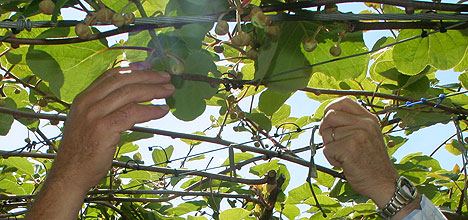
No new cases of the kiwifruit vine disease Psa-V have been reported since mid-December but the industry warns this is only a temporary reprieve.
The warm dry summer conditions are not favourable for the bacteria which thrives in cool wet weather so growers throughout the country are bracing for the disease to become active again in autumn.
No new cases of Psa-V have been reported since mid-December.
Kiwifruit Vine Health says it also suspects reporting of the disease has slowed because of the holiday period.
Currently 2047 orchards in all the country's growing regions, with the exception of the South Island have been identified with Psa-V, 1058 of them in the Te Puke area.
That means 69 per cent of New Zealand's kiwifruit hectares are on an orchard identified with Psa-V, but not every vine on each orchard is infected.
KVH is encouraging packhouse Psa managers and growers to continue reporting on the status of orchards, including visual confirmations of Psa-V so the industry has the most accurate picture of disease progression.
New Zealand is not alone in facing the impacts of the aggrieve disease which has now established itself in Chile and it was to share experiences that a group of Chilean kiwifruit industry representatives recently visit this country.
The group was made up of representatives from Servicio Agricola y Ganadero (SAG), translating to Agricultural and Livestock Service—the equivalent to New Zealand's Ministry for Primary Industries (MPI); and a grower organisation equivalent to NZKGI.
The group visited KVH, MPI, Zespri, NZKGI and Plant and Food Research to understand what processes and policies our industry has in place to help manage Psa-V, and to explore mutually agreed areas of cooperation between the parties.
Chile has recently introduced a regulation that all growers within five kilometres of an infected orchard must take prophylactic and preventative measures to try to control Psa-V. These include total removal of infected gold vines, including roots, and cutting back infected parts of green varieties, along with other vines within 10 metres.
There are currently two regions in Chile that have been identified with Psa-V (Maule and Bio Bio). This is impacting on 3000 of the nation's 12,000 hectares of kiwifruit production.

0 comments
Leave a Comment
You must be logged in to make a comment.