


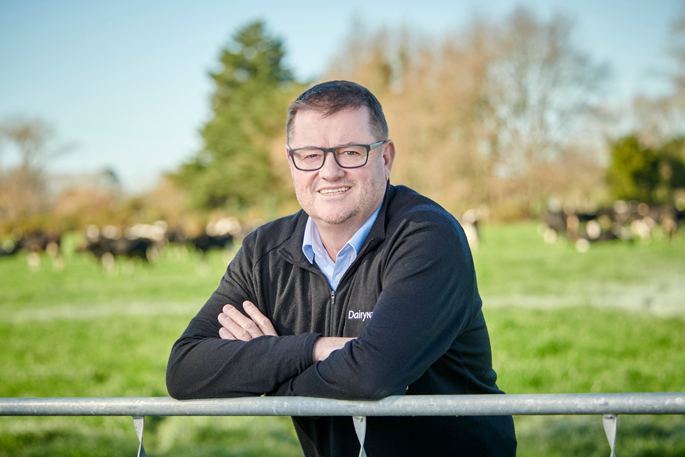
Farmers embracing modern technology is paving the way for a bright future for the dairy industry.
This was highlighted at a panel discussion at an International Precision Dairy Farming Conference held in Christchurch at the end of last year.
Facilitated by DairyNZ’s national key accounts manager Tony Finch, farmers from around New Zealand discussed how Kiwi farmers are succeeding at achieving more with fewer inputs by harnessing technology and modern farming practices
Waikato farmer Pete Morgan’s farm uses advanced systems to monitor various aspects of farm management, from cow health to pasture growth.
He says AI and technology are useful tools to fine-tune operations, without taking control away from farmers.
“Technology and AI are not there to do the work for us, they’re there to assist us,” Pete says.
“It’s useful to predict challenges such as feed shortages and animal health issues, which can help farmers proactively address problems before they escalate. It’s about making our decisions better, not replacing our expertise.”
The conference heard there is a generational shift in farming, with younger farmers increasingly embracing technology, while older generations rely on hands-on experience.
Southland farmer Sharn Roskam highlighted the need to bridge the gap between the two, ensuring that younger farmers learn from the wealth of knowledge held by their more experienced counterparts.
“We need to make sure that young farmers can use technology but still hold on to the core skills that come with hands-on experience,” she says.
“We don’t want technology to take over too many decisions. We need to keep the learning environment alive and maintain the joy of farming.”
Record year
The latest New Zealand Dairy Statistics 2024/25, released by DairyNZ and Livestock Improvement Corporation (LIC), reveals total milksolids production rose 2.9% in 2024/25 to 1.94 billion kilograms, despite a 0.5% fall in cow numbers to 4.68 million.
The lift was driven by record-high productivity per cow, with the average cow producing 414 kilograms of milksolids, up 14kg from last season.
DairyNZ chief executive Campbell Parker says the results reflect farmers’ strong focus on performance and adaptability despite a range of challenges over the past few years.
“Farmers continue to focus on doing things smarter and driving productivity, including managing their herds more efficiently, improving feed use, and leveraging science and technology to lift production per cow, while also responding to higher milk prices last season.
“The trend towards fewer, larger herds is continuing, but the focus on high-performing, healthy animals remains strong, with fewer cows producing more milk,” Campbell says.
“It’s a real credit to farmers’ skill, resilience, and ongoing investment in herd improvement and farm management.
“That combination of efficiency and innovation keeps New Zealand dairy farming at the forefront internationally.”
Campbell says herd improvement activity also strengthened notably in 2024/25, with farmers continuing to invest in data and genetics to support long-term gains.
A total of 3.84 million cows were herd-tested, a 5% increase from last season, with 82% of the national herd now tested in 2024/25.
The proportion of cows mated to artificial breeding (AB) also increased slightly to 81.5%.
Strong commitment
LIC chief executive David Chin highlighted farmers’ strong commitment to genetic progress and herd performance, driven by their focus to lift productivity across their businesses.
“Farmers now have access to the most accurate data and advanced genetic tools ever available, and they’re using these to make very smart, highly targeted breeding decisions.
“The record milk production per cow is no coincidence,” David says.
“It’s the result of decades of genetic improvement and a relentless focus on cow efficiency.
“Genomic evaluations, milk quality and herd testing have all become integral as farmers identify and breed from their top-performing cows.”
David says the long-term trend towards crossbreeding is another sign of farmers’ focus on breeding a balanced, fertile and highly efficient herd.
“Holstein-Friesian/Jersey crossbreds now account for just over 61% of the national herd.
“This reflects farmers’ confidence in cows that combine strong production with high milksolids, good conformation and fertility – key traits for a resilient national herd,” he says.
The average dairy co-operative payout (including dividends) was $10.75 per kilogram of milksolids, an increase from $8.90 in the previous season.
When adjusted for inflation, the 2024/25 payout was $0.90 above the five-year inflation-adjusted average of $9.25 per kilogram of milksolids.
Campbell says dairy farmers continue to play a large role in contributing to the New Zealand economy.
“Looking ahead to the current 2025/26 season, we will likely see the impacts from the extreme wet weather experienced in some regions during spring flow through.
“However, there are some positives, with strong production at the start of the season, accompanied by a stronger-than-average retro payment and reduced interest rates, which will likely improve the cash position of many farmers.”

0 comments
Leave a Comment
You must be logged in to make a comment.