


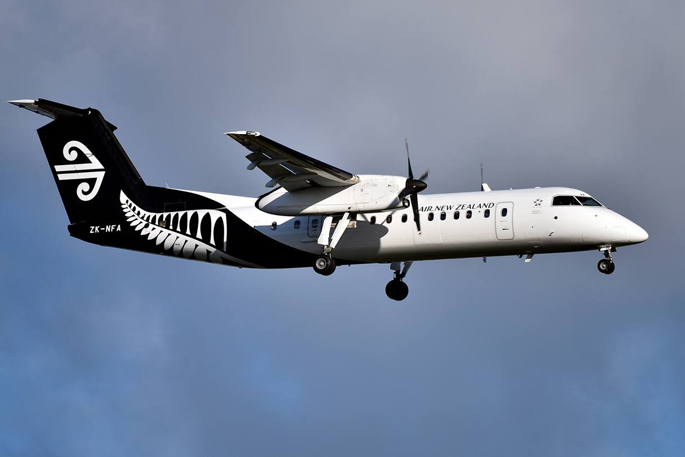
Air New Zealand is temporarily reducing flights to and from Tauranga in response to surging global jet fuel prices from ongoing Middle East tensions.
Air New Zealand chief executive Nikhil Ravishankar this morning said the airline would consolidate 1100 flights affecting about 44,000 customers around New Zealand.
That process would happen in the next six to eight weeks, he told Ryan Bridge TODAY.
That meant about 5% of flights from now until early May would be cut.
Customers would find out from today if their flights were affected.
From March 16 to May 3, service changes to and from Tauranga will be:
-Auckland routes reduced by 31 rotations (averaging one daily round-trip most weeks, but full capacity kept during April school holidays).
-Wellington routes down by 21 rotations (about three per week on average).
-Christchurch routes reduced by three rotations.
A “rotation” means a full round-trip flight.
Bay of Plenty MP Tom Rutherford said today Air New Zealand was rebooking affected passengers on nearby flights and focusing cuts on off-peak times to maintain regional links.
“Reliable flights are crucial for Bay of Plenty, whether for business, tourism, family travel, or medical appointments,” Rutherford said.
“Our region relies on strong transport links to thrive, and as the local MP, I’m dedicated to fighting for the best outcomes for our community, ensuring we’re not left behind in times like these.”
Rutherford said he had sought and received assurances that these changes were short-term only and would not lead to permanent route cuts.
 Air New Zealand chief executive Nikhil Ravishankar. Photo / Michael Craig
Ravishankar said flights to the Pacific and to regional destinations such as Hokitika, Timaru and Taupō were less likely to be affected.
House of Travel chief executive David Coombes called the decision a “pragmatic response to the reality of the conflict in the Middle East and the restricted flow of oil through the Strait of Hormuz, which is the world’s main gateway for oil and gas supply”.
“We’ve seen the price of jet fuel double because a fifth of the world’s oil and natural gas is currently restricted at the source. When an airline’s main operational cost increases that quickly, it forces an adjustment to keep the network functioning,” Coombes said.
“However, this is a pressure airlines the world over have navigated during difficult historical events in the past, and I would say the industry is very resilient and can often stabilise quickly.”
An Air New Zealand spokesperson said that in making these schedule changes, they have tried to strike a balance between maintaining connectivity to all regions and their ability to reaccommodate passengers close to their original booking.
“All customers impacted will be reaccommodated, and will be eligible for a refund or credit if they are unable to fly.”
Oil prices
The global average jet fuel price last week rose 58.4% compared with the week before.
Ravishankar said a normal price for jet fuel was about US$85 a barrel, and it was now at about US$170 a barrel.
“Every cent matters in this game.”
A key challenge for airlines came from the crack spread, which is the premium energy companies applied to refine jet fuel from crude oil.
Ravishankar said the crack spread was “at elevated levels this morning at about US$75″.
Brent crude this morning was trading at US$92.51.
Fuel was the airline’s second-biggest expense after labour in the last financial year, at $1.48 billion.
Government response
Minister of Finance and for Economic Growth Nicola Willis said senior ministers met last night to discuss potential disruptions to petrol, diesel, and jet fuel supplies.
“We are actively monitoring domestic and international fuel supply conditions and assessing any impacts on New Zealand’s energy security,” she said.
“This is a fast-moving situation and New Zealand needs to be prepared for all scenarios.”
Willis said despite that, New Zealand was in a healthy position.
Willis said ministers were told local fuel companies had no major supply chain issues and fuel stocks onshore and in transit were strong.
On Monday, Willis said the country had 28 days of petrol, diesel and jet fuel on hand, with a further 29 days on ships en route.

3 comments
The Master
Posted on 12-03-2026 13:49 | By Ian Stevenson
Fuel cost is one issue, airlines just increase the prices for that...
The real issue is "availability", no plane can fly when that is the issue.
The complete joke of it all here is that NZ has some 50% oil production here in NZ, but no longer any ability to refine it. NZ is therefore 100% vulnerable to anything and everything that happens overseas, i.e. any disruption to sipping anywhere in the world can impact NZ significantly.
So where is the NZ Refinery? Oh, that's right they shut it down and concreted the pipes to ensure that its destruction was permanent...
CANCELLED FLIGHTS
Posted on 13-03-2026 16:56 | By glass1/2 full
AIR NZ is only to happy to "cancel" flights - if it suits them. Oil production is just another tool they can use to keep the flights going where they want them to - AND not where passengers have booked.
@Ian Stevenson
Posted on 15-03-2026 09:27 | By morepork
Marsden Point was closed because it was becoming non-viable in the face of cheaper Asian refineries. The costs to keep it running and maintained were increasing, the ROI was decreasing, and the owners took a commercial decision which was a fair one. No-one foresaw that the US would elect a criminal lunatic who would cause the the whole world energy markets to be radically disrupted.
Concreting the pipes would not disable the refinery; pipes can be replaced, but I was interested to hear that, and wonder why they would bother. Do you have further information on that?
Perhaps, in the interests of "National security" the Government should have stepped in and kept it running, but hindsight always gives us 20/20 vision...
Leave a Comment
You must be logged in to make a comment.