


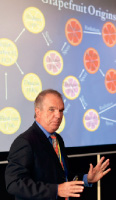
Bio-char and an advanced nutrient formula appear to be helping some citrus trees in Florida overcome the impacts of the bacterial disease Citrus Greening Disease (Huanglongbing), says Dr Fred Gmitter a research foundation professor at the University of Florida.
'Huanglongbing (HLB) is the greatest biological threat to global citrus production and an almost parallel situation to what New Zealand is dealing with, with Psa-V in kiwifruit,” he told kiwifruit growers at the Zespri conference in October.
Citrus trees have no known genetic resistance to HLB but there is some difference in sensitivity.
'Some die quickly, others develop symptoms but grow out to become very productive, but none have immunity.”
Fred said by the time the Florida citrus industry realised the disease was in its trees, around 40 to 50 per cent were infected. HLB is spread by the Asian Citrus Psyllid and because the bacteria are inside the plant, they can't be controlled by sprays. Scientists have so far been unable to culture the bacteria in the laboratory so can't establish its DNA.
Initial recommendations from plant pathologists were to cut out all the diseased trees and replant with uninfected ones but Fred said that was not an option because it would have destroyed growers' incomes.
China has had the disease for around 100 years and remains among the top seven citrus producers in the world. It has achieved this by a ‘scorched earth policy' in which diseased trees were removed and orchards re-planted with healthy ones. An intensive and co-ordinated spray programme sees all neighbouring growers spraying to kill the vector insect at the same time, and trees are fed a rich diet of manure and fertiliser to improve their health.
Sugar Bell
Fred said his research team has been working on developing rootstocks which may improve the trees' chances of survival and one such trial involved a new fruit variety called Sugar Bell.
'Three years ago the trees in that trial looked so miserable we thought it was a disaster. Every plant was infected but the grower asked if there was anything we could do. We had been working for some time with a slow release fertiliser with a different formulation of nutrients and a substance called bio-char which is one step away from charcoal. 'We began to use the advanced nutrient approach and bio-char and the trees are still healthy and commercial varieties in the same orchard have improved somewhat.”
There is tremendous diversity within citrus but it has a very narrow genetic base.
However, thanks to the work of the International Citrus Genome Consortium, the citrus genome has been sequenced.
'What we have learned shows there is promise there.”
Scientists can now begin to look at parents and hopefully re-create sweet orange, bringing in other genetic elements such as those from lemons which have some tolerance to disease, using conventional breeding techniques.

0 comments
Leave a Comment
You must be logged in to make a comment.