


Thirty-one years ago when Russell Lowe was asked to help establish a research orchard in Te Puke, the focus was to be citrus and subtropical fruits, not kiwifruit.
However, it was not long before kiwifruit were planted, sparking Russell's interest in the fruit which led to the development of one of the fruit industry's most impressive success stories of modern time.
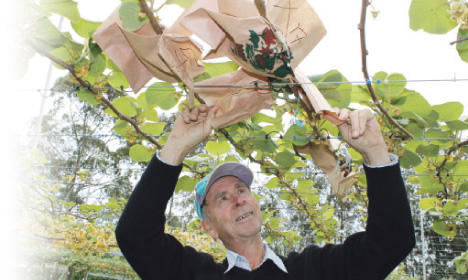
A pollination trial for new varieties is Russell Lowe's current project.
For his work in developing and helping to commercialise the gold kiwifruit Hort16A which has added around $3 billion to the industry and the New Zealand economy, Russell has been awarded the inaugural Hayward Medal.
The new award is named after another great horticulturalist and kiwifruit breeder, Hayward Wright, whose innovation and contribution established the industry. The kiwifruit Industry Advisory Council (IAC) established the Hayward Medal and IAC chairman Bruce Cameron presented Russell with the award at Zespri's kiwifruit industry Momentum conference, saying his work defined the kiwifruit industry
Leadership
'Hort16A was the first cultivar to provide a real alternative to the green variety Hayward and helped cement the world leadership of the New Zealand kiwifruit industry. This cultivar has proven recently challenged in the context of Psa but has been incredibly profitable and established the gold category for the future.
'Russell's 41-year career at Plant & Food Research's Te Puke Research Centre saw him establish the orchard and kiwifruit breeding programme and it is this work, and the body of knowledge he helped create, which now holds our best chance for a breeding solution to Psa,” said Bruce.
Plant breeding wasn't a career the young Russell Lowe imagined for himself when he began a science degree at Canterbury University. The eldest of seven children, Russell completed his college education at Timaru Boys' High School.
Peas
The need to finance his education saw Russell picking peas seven days a week during university holidays and then working on the horticultural property owned by Tony Burnett in the Horotane Valley above Christchurch. 'Tony grew apricots, cherries, plums, lettuce and chrysanthemums and I enjoyed the outdoor, practical work.”
When he graduated, Russell joined the DSIR orchard at Nelson where breeders were working on new apple varieties including Gala and Braeburn.
In 1971 Russell was asked to head north to establish a new research orchard at Te Puke.
'Citrus growers in the Bay of Plenty had been asking the DSIR for some time to establish a research orchard in their region, so the department bought 60 acres of a dairy farm from Neil Robinson in No. 1 Road,” says Russell.
Windswept
'The land was fairly flat, with a few gullies. Our first impression was it was windswept and much colder than Nelson, but that's all changed with the shelter planted on this orchard and others around it.”
Initially Russell and his wife Veronica lived in the house the Ministry of Works built on the orchard and Veronica (who is a qualified teacher) was the unpaid receptionist and telephonist, operating from an office in the spare room in their new home.
Ministry of Works staff helped contour parts of the orchard, design and install irrigation and dig bores for the water supply. Local orchardists also lent a hand.
Plantings included grapefruit, lemons, tangelos, mandarins, macadamia, feijoa and nashi. There was also a block of virus-free stone fruit trees used for the collection of budwood.
Citrus had dominated the Bay of Plenty horticultural landscape with fruit grown for export, local consumption and juice. However, falling returns and battles between growers and the Citrus Marketing Authority led orchardists to look for alternatives and by the 1980s citrus trees were being cut out and replaced with kiwifruit.
Kiwifruit
'In 1972 block four of the research orchard was planted in Hayward kiwifruit and those vines are still here and so far surviving, despite Psa,” says Russell.
The research orchard is close to where the vine bacteria Pseudomonas syringae pv actinidiae (Psa-V) was first discovered in New Zealand in 2010.
The research orchard had a collection of the named kiwifruit varieties (all green) Bruno, Abbott, Monty and Allison and much of the early research and breeding work involved looking for useful plants and rootstocks growing on commercial orchards.
In 1984 Russell had a last minute chance to join an apple grower's trip to China.
China
'Don MacKenzie, the Hawke's Bay breeder of the Splendour apple, had arranged a 10-day tour of China but one grower couldn't go, so the department came up with some money and I found the rest.”
It was a tantalising trip as Russell got to see, but not closely examine, kiwifruit growing in a botanical garden.
'The Chinese weren't keen to let us get too close to the plants.”
With plans to build the three gorge dams on the Yangtze River, the Chinese government began to welcome the help of New Zealand scientists in identifying and collecting kiwifruit plants from the wild and setting up a collection centre in Chengdu.
'There was concern that many plant varieties, not just kiwifruit, could be lost by the flooding of the gorges and the re-location of settlements.”
Russell returned in China in 2003 and 2004, attempting to time the visits just before wild fruit was ripe and locals picked it for sale.
Wild kiwifruit are found on the edges of the forest or in clearings, where there is light, and often grow up trees. 'They are not as vigorous as in New Zealand, partly because of the soil conditions and the fruit is generally quite small.”
GPS
Chinese assistants often scaled the vines to pick fruit for the collectors. 'We used a GPS to record the location of plants so that if we found something especially interesting, we could return.”
It was as a result of this co-operation between Chinese and New Zealand scientists that the Te Puke research centre built up one of the largest and most comprehensive kiwifruit collections in the wold. The arrival of Psa put that collection under threat.
'As soon as we knew Psa was in the area we took steps to protect our collection by saving seeds and taking cuttings to be propagated in Palmerston North and we have plants in orchards in Kerikeri and Nelson. The concern now is that Psa is also in the Kerikeri area.”
Hort16A
It was apple breeder Don MacKenzie who imported the first seeds which led to the breeding of the highly successful Hort16A gold fruit.
'The mother of this variety was selected by Mark McNeilage and Alan Seal from a second generation of the seed Don imported in 1977. It had good taste and reasonable size compared to most of the seedlings and a bit of red around the core.
'The father was selected by Mark and Alan from a seed introduction made in 1981 on the basis that its female siblings had good fruit size. Mark made crosses in 1987 and more than 300 seedlings were planted out at Te Puke in 1988.
'The female, later known as Hort 16A (because of where the plant was growing in block 37) first fruited in 1990 and was selected by myself and Hinga Marsh because of its large size and unique tropical taste.”
The initial trial blocks of the new gold fruit were planted in 1992 in No. 3 Rd and large scale trials followed.
Monster
'Growers were worried about the rapid and continuing growth throughout the season of the monster plant, and how it could be managed. There was also concern about its distinctive ‘beak' and how that would affect picking and packing.”
Those concerns were justified but growers and consumers loved the colour and the taste of the fruit, marketed under the Zespri brand.
'The success of the commercial development of Hort16A was due to the close partnership between researchers, growers and marketers. Without this gold kiwifruit would not have become the market success it was,” says Russell.
Key issues were new pollinators, canopy and pest management, harvest maturity, optimal storage conditions, all of which Russell played a part in, along with other breeders, research orchard staff, physiologists, post-harvest operators, growers and entomologists.
Russell is sad that Psa has meant the end of the Hort16A variety, in the Bay of Plenty at least, but he believes that the industry will survive.
'The Gold 3 and Green 14 varieties may give time for new tolerant material to be identified from a greatly expanded breeding population base. It is encouraging that there is a range of tolerance in our germplasm and breeding populations as a basis for moving forward, and the industry has given urgent priority to support this work.”
Russell has semi-retired but he's still at the orchard three days a week. His most recent project has been a pollination trial to identify which of the tolerant males on the orchard will prove the best pollinators for new varieties.
Russell's interest in the industry goes beyond the fact that he has devoted a significant slice of his career to the fruit. 'Kiwifruit is worth growing because it is so nutrient dense – it's a fruit which is good for you.”

0 comments
Leave a Comment
You must be logged in to make a comment.