


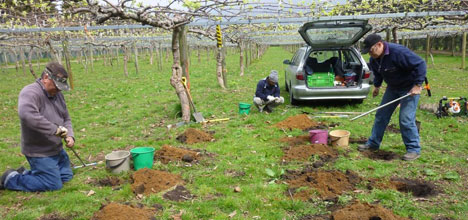
A Te Puna based plant research group has discovered kiwifruit puts more carbon in the soil at a greater depth than pasture.
A report by PlusGroup Research and Plant and Food Research shows kiwifruit locks up about 90,000 tonnes of carbon in soil each year.
The project, funded by Zespri International Ltd and the Ministry for Primary Industries' Sustainable Farming Fund, measured soil organic carbon in 104 Hayward Green and Hort16A orchards across the kiwifruit-growing regions of New Zealand and estimated the rate at which kiwifruit vines convert atmospheric carbon dioxide (CO2) to soil organic carbon in a process known as carbon sequestration.
Zespri Innovation Leader for Sustainability Alistair Mowat says the study showed soil nine metres below a 30-year-old kiwifruit orchard had significantly higher levels of carbon than pasture soil at the same depth.
'Essentially, we are growing new soil at depth. This has important implications for the industry – global retailers are looking for food suppliers which are more resilient to extreme events like flooding and drought. Soil carbon is a critical factor here, as the carbon content of soils is a clear indicator of soil health.”
Allister Holmes of PlusGroup Research says the findings challenge current thinking and orchard management practices across New Zealand's perennial tree crop industries including avocado, pipfruit and summerfruits. 'This could potentially lead to significant financial benefits for growers and ecological benefits for New Zealand.”
Ultimately, changing orchard management practices to increase carbon sequestration rates and SOC will deliver significant ecological benefits to surrounding land and downstream waterways, contribute to reducing the kiwifruit industry's carbon footprint, and are likely to provide financial benefits to the grower in the long-term, says Allister.
Increased soil carbon means an increase in the water-holding capacity of the soil, which helps buffer crops against extreme weather events such as heavy rain or drought.
'Sequestering carbon from the atmosphere into the soil also helps offset the carbon emissions involved in growing and distributing kiwifruit. Produce from New Zealand is regarded as ‘clean and green' and it's work like this which helps us verify those claims,” says Alistair.
More soil carbon also helps orchards withstand soil loss and improves soil aeration, as well as improving the efficiency of water and nutrient use, leading to lower costs for growers.
Growers could use this understanding of the soil organic carbon profile of their orchards to improve and maintain carbon levels, which would have significant benefits for surrounding land and downstream waterways.
This may mean less nitrogen is applied and less irrigation is needed, as more water is retained in the soil. This approach to land management would fit well with the findings of the recent report from the Land and Water Forum, to which Zespri contributed.
In the first study of its type, undertaken within the New Zealand kiwifruit industry, researchers measured Soil Organic Carbon (SOC) and estimated the rate at which kiwifruit vines convert CO2 to SOC in the process known as carbon sequestration.
SOC is a critical natural capital for primary producers. Soil rich in organic carbon provides growers with a natural advantage and numerous production benefits.
The soil has a greater ability to store water and nutrients, high levels of healthy microbial activity, and may contribute to the natural control of potential agricultural pests. High levels of SOC are known to improve soil drainage and enhance root penetration, ultimately protecting kiwifruit vines from the effects of both extreme wet and dry periods synonymous with climate change.

0 comments
Leave a Comment
You must be logged in to make a comment.