


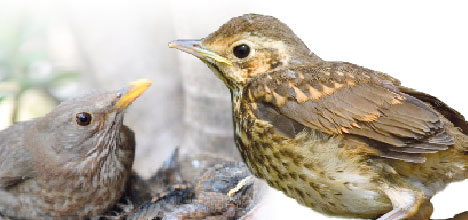
Spring has arrived and with it our usual onslaught of orphaned and injured wildlife, mainly baby birds.
Especially after windy weather, we are inundated with baby birds brought in by well-meaning and concerned people but often they're better off without our intervention.
Many of these are fledgling birds (usually thrushes and blackbirds) that have just left the nest. They can often fly or at least hop around quite efficiently as they're learning to fly and have their parents in close proximity watching over them.
It is best to observe them from a distance to assess if they have any major injuries such as a drooping wing or bleeding area. This being the case, intervention is appropriate and they can be gently caught and brought in for care.
For uninjured fledglings, they are best left to be raised by their parents. Where possible, return these birds to the nearest tree or hedge (difficult for cats to penetrate), or place them in a box at a height – an ice-cream box can have drainage holes punctured in the bottom, be lined with wood shavings or leaves and be hung from a branch or even a clothes line.
It is a fallacy that handling a baby bird will deter their parents from caring for them but try and keep handling to a minimum.
Watch to see that their parents return, (they usually do once they hear their offspring calling) and if they don't return or there is a high risk of cats in the surrounds that might prey on them, then re-consider intervention.
Non-native species such as thrushes and ducklings may be hand reared. They require feeding 2 – 3 hourly (but thankfully not through the night!) for 3 to 5 weeks.
If you are keen to help us foster these baby birds, please contact Sue Mackey [email protected] or 552 5503.

0 comments
Leave a Comment
You must be logged in to make a comment.