


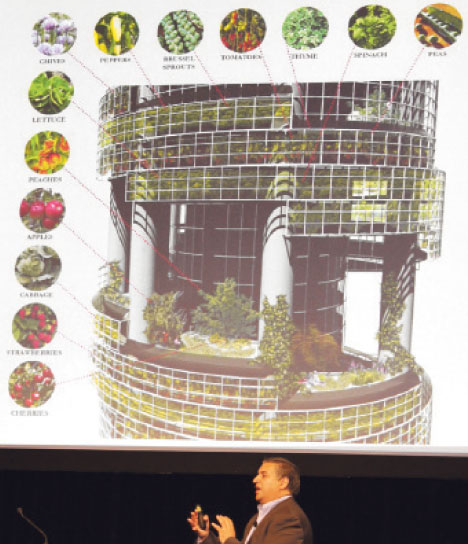
Vertical gardens, technologies to make us smarter, mega cities of 120 million people and humans who live to 190 may be part of our future, according to Rohit Talwar, global futurist and director of Fast Future Research and Trends.
Rohit, who advises organisations on how they can adapt and thrive in response to emerging trends and technologies, gave the kiwifruit industry a taste of what the future might bring when he spoke at the Zespri Momentum Conference in October.
Vertical gardens are already a reality, Rohit Talwar, global futurist told the Zespri Momentum Conference.
While growing food in multi-storied structures, and electric and drug stimulations to aid learning are already here, the ability to extend life expectancy is close, he said.
'Scientists have identified a protein in a worm called a nematode which controls aging. When they stop its functioning, it extends the life of the worm three to five times. They think they have found the same protein in humans.
'What would you buy your parent for their 200th birthday? Just think about marriage lasting 130 years.”
A saliva sample can be analysed to map our personal genetic profile. 'It can tell what drugs have positive and negative indications for us, what diseases we may catch or carry, how long we are likely to live. Within a few years there will be an app so when you go to a restaurant you wave a phone over the menu and it will tell you what you can and can't have because of what each dish contains.”
Rohit said the more immediate future is one of economic crisis.
'We are in the very early stages of the global economic crisis. There is massive shift in wealth and power from west to east.”
China and Asia will become dominate forces in the world economy but it won't be a smooth path because issues around infrastructure, lack of transparency in government, fresh water and environment pressures will slow growth.
New Zealand can't rely on a recovery of the global economy for at least a decade and must use its own resources and innovations to drive growth.
The growth of mega cities with huge populations will be among the forces increasing energy demands by 20 to 30 per cent by 2022 and every business will need to become more self-sufficient in energy to control its cost base.
'New materials, naturally occurring or man-made which sound like they stepped off the pages of Star Trek will be available, like indestructible, self-repairing concrete and glass, cutting the costs of owning buildings and speeding construction time.”
The internet will become multisensory.
'When you book your hotel online, you will be able to feel the bed linen, smell, even taste the food.”
Zespri could ask consumers, online, for their taste preferences for a new kiwifruit.
'Empowering the consumer can drive new markets by getting the end consumer to say what particular variety of organic gold they want their supermarket to stock. The technology opens up a huge wave of opportunities.”
The biggest area of shock in the next decade will be the use of human enhancement.
It's a technology which has gone largely under the radar, said Rohit. Already 20 per cent of university students in the US are using the drug Ritalin, designed to help with attention deficit disorder, to concentrate their mental performance.
'We have more understanding of how the brain works through technologies like transcranial direct current stimulation, which applies a micro charge to the brain. Using this, the US army has halved the time it takes to train pilots to fly drones.”
The technique has dramatically improved maths abilities and, once applied, the change in performance is enhanced for up to six months.
'If we are able to enhance ourselves, we will have to make choices. If we see a competitor do better, do we give our staff enhancement? If you kid comes home and says ‘Sammy gets 100 per cent in tests and she has had chemical, genetic or electric enhancement and can I have one please?' – what do you do?”
Rohit said there were several possible future scenarios for the food industry in particular.
One is that in the next 10 to 20 years there is a breakthrough in energy or technology which reduces the reliance on fossil fuels. Food production improves in developing economies, and health improves but a segment of the world still suffers poverty.
The second is a major food scare, or even poisoning in the food chain, so the focus turns to local markets, buying locally and innovation in producing food locally.
A third possibility is a collapse of the global economy which could see the disappearance of food and vegetable retailers, with most people not getting access to fresh foods. Super foods will be developed but half the world would be in poverty.
Another possibility is a transformation in how meat is produced. Experiments are underway in the Netherlands to grow meat in the laboratory, freeing up arable land to grow more fruit and vegetables.
The future is not a place, it is a continuing and very turbulent journey but for those who were prepared for change and to try new things it also offers significant opportunities, Rohit said.

0 comments
Leave a Comment
You must be logged in to make a comment.