


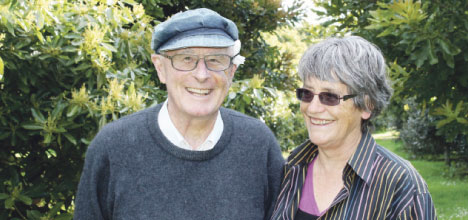
Worms, trees, birds and bees have helped a Katikati couple ‘heal' a piece of land on the fringes of Tauranga Harbour and create a lifestyle radically different from their previous urban experience.
Fifteen years ago when John and Thelma Williams moved from Auckland to live full-time in the family bach John's father had left him, they began the process of developing the adjoining neglected acre of land they had bought.
John and Thelma Williams have created a ‘forest' of food trees at Pottsbury Farm.
'The land had been used to grow vegetables for the American troops during the war and continued as a market garden for many years but when we bought it, it was neglected pasture and the soil was so compacted it was hard work just digging it,” says John.
John and Thelma met when they were teachers at Manurewa High School and John was later to become an Auckland City councillor. Both loved the idea of a self-sufficient lifestyle in the country but neither had the practical experience of how to make that happen.
'We tried growing garlic which wasn't a success and then sweetcorn which wasn't successful either. Avocado orcharding was just starting so we decided to give that a go, along with citrus and feijoa trees.”
Today the 5.5ha Pottsbury Farm organic orchard at Ongare Point grows 46 different types of fruits and nuts. The main crops are avocado, macadamia nuts and feijoa and others include lemons, oranges, grapefruit, bananas, casamiroas, cherimoyas, olives, cork oaks, pecans, walnuts, almonds, babacos, pepinos, mountain pawpaw, passionfruit and one coffee tree.
'No-one knows what impact climate change may have on this region so we are keen to experiment to find out what will grow here in the hope that information might be useful to others,” says John.
The couple are keen advocates of the New Zealand Tree Crop Association and recommend anyone with an interest in growing cropping trees to join.
'Its members have so much knowledge they are willing to share and the field days are fascinating,” says Thelma.
The soils at Pottsbury are now rich and friable but they have not been ploughed.
'We basically dug holes to plant the trees and then fed them with lots of mulch and worm tea.”
The Williams discovered worm farming in 1996 when they attended a lecture in Auckland called ‘The Wonderful World of Worms'.
'What we heard about worms made a lot of sense and from that meeting the New Zealand Earthworm Association was formed,” says Thelma. John became editor of the newsletter ‘Wriggles' and Thelma its secretary, roles they held for five years.
'Worm farming was very new to New Zealand and a group of us went on a 10 day trip to see farming in operation in Australia and it was fascinating.”
The couple set up their own worm farm which is today a series of 14 old baths on frames, collecting worm tea from buckets placed underneath the plug holes. The worms are fed kitchen scraps, paper and cardboard, producing in return a rich mulch called vermicast or worm humus which is spread around the trees. The worm tea is sprayed on to foliage as a liquid fertiliser and worms are also sold to help others establish their own farms.
'This is all we have done to enrich the soils and the response has been amazing,” says John.
In 15 years the land has gone from a bare paddock to a ‘forest' of food trees, inhabited by birds, bees and other insects.
'Sometimes I wonder if we are farming birds, there are so many of them, but that's great because they do so much for us by controlling the insects.
A fantail might be tiny but it can eat its own weight in insects in a day. I don't mind if we share some of our fruit with the birds in return for their pest control work,” says John.
The orchard has also become a haven for 40 beehives, placed there by a local beekeeper who values the environment safe from sprays and overhead transmission lines. In turn the bees pollinate the fruit and nut trees.
Every year Pottsbury Farm produces a crop of avocados and although the trees have ‘off' and ‘on' years, the differences are not extreme. The reject rate through the packhouse is low and because the fruit are organic, they are in demand from private customers too.
Macadamia are another crop Pottsbury produces and in the past has sent regular shipments to the owner of a McCaw parrot in Norway who liked to feed his very expensive bird only the finest organic foods.
The orchard has been the subject of research projects by university students, including Severine Brun from France who came to stay as part of practical experience for her science degree and has returned several times since. Australian worm expert and scientist, the late John Buckerfield and his colleague Katie Webster are among these to visit Pottsbury Farm and every year Bay of Plenty Polytechnic Agritec students use the farm as part of their studies.
John and Thelma have inspired hundreds of other to take up worm farming, either to turn their own household and garden waste into something useful, or on a larger commercial scale and they are thrilled worms are finally being recognised for the wonder workers they are.
'Now councils have taken over much of the role of promoting worm farming and it is possible to buy home worm farms from retail stores,” says Thelma, who has a special affection and admiration for the previously much-maligned creatures.
In 2008 Pottsbury Farms won the Ballance Farm Environment Award lifestyle award in recognition of their sustainable management practices and the diversity of crops produced.
John and Thelma also enjoy sharing their special piece of paradise by hosting guests in Pottsbury Farm's holiday cottages.

0 comments
Leave a Comment
You must be logged in to make a comment.