


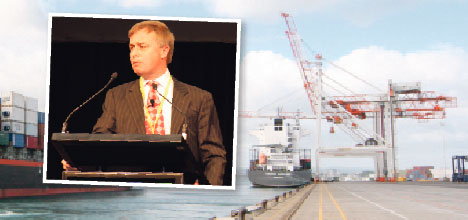
New Zealanders need to develop an appetite for risk and a pride in being Kiwi in order improve this country's economic performance John Allen, chief executive of the New Zealand Ministry of Foreign Affairs and Trade believes.
In an energetic and enthusiastic address to the Zespri Momentum Conference in October John said this country is poised to ‘take off' in so many markets and while there is much to celebrate about New Zealand's successes, more need to be done.
Confident of our success – John Allen, chief executive of the New Zealand Ministry of Foreign Affairs and Trade addresses the Momentum Conference.
'As a country we need to confront our attitudes to risk taking. We do not support the risk taker nor learn from risks taken but rather sit awaiting failure and celebrate that.
'If we are to lift exports as our government intends us to by 30 to 40 per cent of GDP, we need take more risk. Not bet the whole shop but take considered managed, informed, scientifically founded risks to grow our businesses. At the moment our attitude to risk is too often to shoot the messenger and celebrate failure rather than support those taking risks and learn from them.”
Attitudes to growth also need to change, he said. With contemporary science, technology, education and practise on farm it is perfectly possible to increase productivity without impacting adversely on the environment.
'We need get out there and help grow our country because a country which is not growing will not create the opportunities our people need. If we want our children and grandchildren living and working in this country then we have got to grow the capacity and capabilities of this country.”
New Zealand's xenophoic attitudes to foreign investment also need to change.
'Foreign investment is pivotal to unlocking and securing our success. We have made really good progress in attracting investment but need to develop a new model of internationalisation of business bringing Kiwi intellectual property and foreign capital together.”
John said the New Zealand, or Kiwi brand was well respected and indeed envied internationally.
Those who said New Zealand need to be more like Australia and America, 'needed more swagger and aggression, that Kiwis were to nice, too deferential too egalitarian - too Kiwi”, were wrong.
'The brand Kiwi must be a Kiwi brand. It can't be other than authentic in the way we market ourselves and our products off shore. We need to be proud of who we are and confident as a nation to present ourselves on the world stage and be met with absolute admiration and achieve impact.
”Our cultural diversity and the partnerships that under pins it is what differentiates us on the world stage. When we are out there marketing this country time and time again we anchor ourselves in our Maori culture, our Maori tradition and in our pride in Tangata whenua.” He acknowledged the role Maori played and continue to play in building Aotearoa New Zealand and the future contributions they will make to the nation and the kiwifruit industry in particular.
New Zealand needed to ensure its products were world class and its farming and orcharding methods sustainable. 'The claims we make about 100 % pure have to be sustainable and that means a focus on the management of water quality, carbon foot print and greenhouse gases and the way in which farms and orchards are managed. It means making sure we are telling that story on the world stage.”
John said he was optimistic about the future even though everyone around him was giving reasons not to be. 'People keep telling us New Zealand is a small remote country with no strategic advantages. Big countries like China, the US and Russia are jockeying for position. There are hot spots of conflict in the South China Sea and lots of terrorism, plaque, petulance and global warming , but I am confident this country can continue to successfully make its way in world.”
Part of that confidence is due to burgeoning middle class in Asia predicted to grow to 2.3 billion by 2025, hungry for food that tastes good, looks good and is good for them, New Zealand is well placed, and well experienced to take advantage of existing and new trade agreements. Collaboration between government, businesses, industry, universities and science institutions are also an advantage brought by New Zealand's relatively small size that other countries don't enjoy, he said.
# John Allen has been chief executive and secretary of Foreign Affairs and Trade since July 2009. He is the government's chief adviser on foreign and trade policy, official development assistance, international law and diplomatic and consular issues. Prior to joining the ministry, John was chief executive of New Zealand Post, where he led a range of initiatives to drive growth in the face of declining mail volumes. A former partner in Rudd Watts & Stone, specialising in commercial and public policy issues, John has also been a visiting lecturer at Victoria University of Wellington.

0 comments
Leave a Comment
You must be logged in to make a comment.