


The annual Guy Fawkes Day today is the second anniversary of the day the New Zealand kiwifruit industry was blown apart, not by explosives, but by aggressive bacteria.
The vine disease Psa-V (Pseudomonas syringae pv actinidiae) was first discovered in gold kiwifruit in a Te Puke orchard on November 5, 2010.
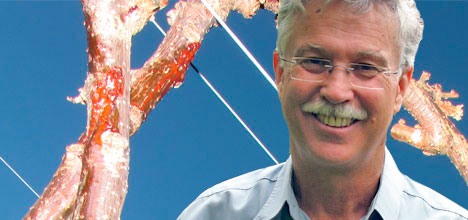
Neil Trebilco president of the New Zealand Kiwifruit Growers Inc.
The economic and emotional impact of Psa is a disaster far greater than the grounding of the container vessel Rena on Astrolabe Reef in October last year, says New Zealand Kiwifruit Growers Incorporated president Neil Trebilco.
'The Rena was a more visible disaster but economically the impacts of Psa on the Bay of Plenty will be 10 times worse and potentially up to 50 times worse over time.”
While the Rena's impacts on wild and marine life, beaches and businesses played out in full view, the death of kiwifruit vines behind shelter belts in the rural hinterland has continued, largely unobserved by the public.
'The impacts of the disease are relentless on growers and the wider industry and the full effects have yet to be felt in the regional towns of Te Puke, Katikati, Opotiki, to some extent Whakatane and these will flow on to affect Tauranga as well.”
Zespri chairman John Loughlin says two years on from the discovery he is bitterly disappointed the disease has now been found in the Waikato, South Auckland, Hawke's Bay and Kerikeri.
'It was hoped outlying regions could hold the markets open for gold while the recovery was underway in the Bay. We may still be able to do that but will not be as strong as we wanted to be.
'When you have bacteria that doubles every 20 minutes, and is highly prone to being blown around in cold wet conditions, the probability of protecting neighbouring areas is slight. However, it had been hoped geographic barriers would keep it out.
'We are yet to see a Hayward orchard where all the females are dying, but we are seeing some infection in females and in Hayward males.
'With G3 (new gold variety) some orchards have fantastic outcomes, better that our best hopes. Others are tragic disaster, some because of grafting and some because of Psa.
'What we have learned is that Psa is at its most vicious in situations where the vines are under stress be it from wet feet because of high water tables, in frost prone areas or areas with poor shelter. When the vines are facing another stress, they are more susceptible to Psa.”
Growers achieving good outcomes are those who are diligent, vigilant and are approaching kiwifruit in the way many in the pip and stone fruit industries grow fragile crops including using protectant programmes.
'There are at least 50 different (commercial) plant species, which are infected by the pseudomonas bacteria and in no case has a crop been totally wiped out, but in no case has the bacteria been wiped out either.
'We have to apply the tools which are available to cultivars which are viable – Hayward, Gold 3 and G14, not Hort16A. It is doable and I believe in the future of this industry,” says John.
In its heyday the kiwifruit industry generated $2 billion in flow on revenues for the Bay of Plenty region and accounted for just less than 20 per cent of the region's annual GDP.
An economic impact report estimates that Psa will cost the industry between $310m-$410m in the next five years; $500m-$600m in the next ten years; and $740m-$885m in the next 15 years.
The effect on regional economies and related businesses will push the total cost of Psa much higher.
It is the highest earning variety, Hort16A, which has succumbed to the disease, with virtually no gold orchards left in Te Puke now.
Hort16A once accounted for 60 per cent of the industry in terms of value.
NZKGI estimates around 1800 hectares has been grafted to Gold3 at a total cost of around $60 million. Gold3 will not start producing a crop for two to three years and each hectare is likely, due to Psa-V, to have less than a full canopy.
Based on this year's figures across the industry (before on-orchard expenses, debt repayment and drawings) that equates to a staggering $182 million of income not coming back to kiwifruit orchardists each year until they can grow a crop, says KVH.
Hort16A has little resistance to the disease which can kill the plants. Hayward green was thought to be more tolerant but Neil says some Hayward orchards have been harder hit by Psa than expected and will not produce a crop this season.
'However, some orchards hard hit last year are looking good this year, including those in the area where Psa was first identified. It remains to be seen whether Hayward can grow through the disease,” says Neil.
The industry has placed its hopes for recovery on the new gold G3 variety that had shown more tolerance to the disease but is not immune.
'Some growers are struggling with G3 and others are doing ok,” says Neil.
'Psa has changed forever how we grow kiwifruit. In sense until now we have been lucky as kiwifruit has had relatively few bacterial diseases and was relatively easy to grow. That's all changed and we have now joined the rest of the fruit growing industries, which have battled diseases like this for years.
'The industry will come back from Psa but there are some hard lessons to learn along the way. Growers are innovative and we have to learn collectively and fast to recover.”
However, some growers will not survive the impacts of Psa he says.
As of last week 1751 orchards in all growing regions except Whangaeri, Auckland, Poverty Bay, Wanagnui/Horowhenua and the South Island had some infection, representing 61 per cent of the industry.

1 comment
So Going Forward
Posted on 06-11-2012 08:00 | By wonkidonki
Can anybody tell us what exactly the plan is going forward to contain or eradicate PSA? .....Um...Um we dont have one !
Leave a Comment
You must be logged in to make a comment.