


A Katikati kiwifruit grower is optimistic this summer will provide a better environment for grafting new kiwifruit varieties than winter months based on findings from a recent visit to Italy's kiwifruit region.
Grower Craig Lemon visited Italy in September and says growers coping best with the disease are those maintaining a protective spray programme and ‘working with the environment' to minimise orchard work when conditions are wet.
He says bacteria in Psa-V is less active during the summer months.
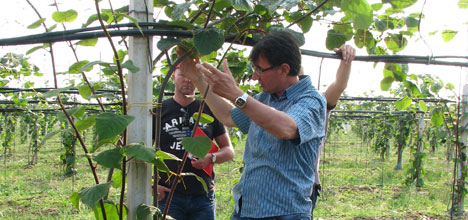
This Italian grower pictured in 2011 had cut out diseased Hort16A vines and allowed four Hayward suckers to grow from each stump, producing a full productive canopy this season.
'I saw green orchards, which on first sight looked healthy and were producing a crop. On closer inspection you could see the Psa-V cankers but they had dried up in the summer heat. Growers and Zespri staff said those same orchards didn't look pretty in spring when Psa was very active.”
It was Craig's third visit to Latina, Italy's primary kiwifruit region. He went there in 2009 and then in May 2011 when he was part of the first New Zealand grower group visit.
He says what he saw on this most recent trip gives him more confidence about the industry's future in New Zealand.
'One young orchardist we visited this year, who had Psa-V, told me he didn't go into the orchard unless he could feel the sun on his face – in other words he did pruning and summer work only when it was fine and sunny.
'In addition to operating a protectant spray programme the grower was also checking his blocks on a regular basis and removing any suspect material. And when you look at his orchard compared to all the neighbours it is like night and day.
'Both his green and gold blocks were like an oasis in a desert. And he has had Psa since 2009.
'New Zealand doesn't have the luxury of long hot summers that they enjoy in Italy and our wet conditions last summer and through this winter have helped Psa-V thrive, but we should be thinking about what we are doing in orchards when conditions are right for the spread of Psa.”
On one of the Italian green orchards Craig visited in 2011 and again this year, diseased Hort16A vines had been cut out and four Hayward suckers allowed to grow from each stump. 'The suckers had grown through the summer, resulting in a canopy which is producing a crop this year.”
Craig believes the New Zealand industry must now take a longer view of how it redevelops kiwifruit in a Psa environment and that might include moving to summer grafting instead of winter, especially in areas where there is high levels of Psa inoculum.
'Late autumn, winter and spring are the times when conditions are favourable for Psa and vines most vulnerable.
'Grafting in winter might make sense from a bank manger's view point because it appears the quickest way to re-establish a crop but I think we need to take the longer, three to four year view and look at grafting in summer to give the new graft scions the best possible chance to grow and develop during the hottest part of the year.”
Instead of leaving soft late season shoots to be exposed to early winter frost damage and subsequent Psa infection, he wants growers to consider cutting back to strong hardened off material which may be in a better position to develop following spring.
This means it will take a longer time to develop a complete canopy but it might be in a healthier state in the long run.
'This is the approach that I saw in Italy and you have to take notice of the results they are achieving.”

0 comments
Leave a Comment
You must be logged in to make a comment.