


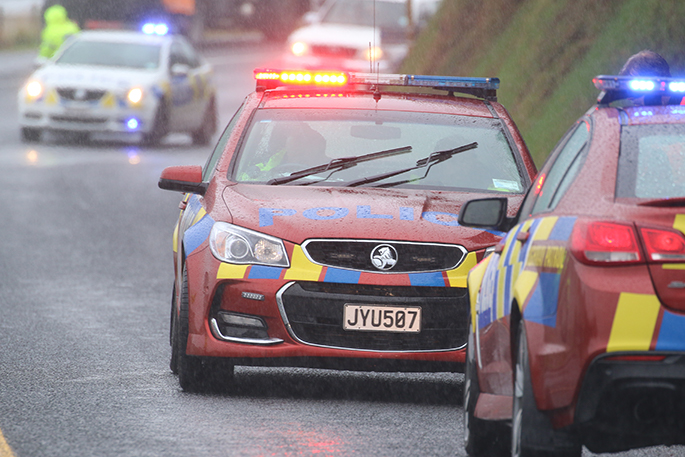
A horrific fatal crash in Te Puke has left a community traumatised, says a Boucher Ave resident.
Steve Nicholson and his teenage son were amongst the first at the grim scene outside their house on Boucher Ave. His account of what they saw is disturbing.
'There was no blood, no screaming,” says Steve, who later helped cover the scene.
'People are traumatised and shocked. Twenty people directly affected by Saturday's crash have suffered a huge traumatic event.”
The incident that impacted their lives, as well as the lives of the victims' families and loved ones, happened at a curve in Boucher Ave around 4.30pm on Saturday, April 15, when a motorcyclist died following a crash with a truck.
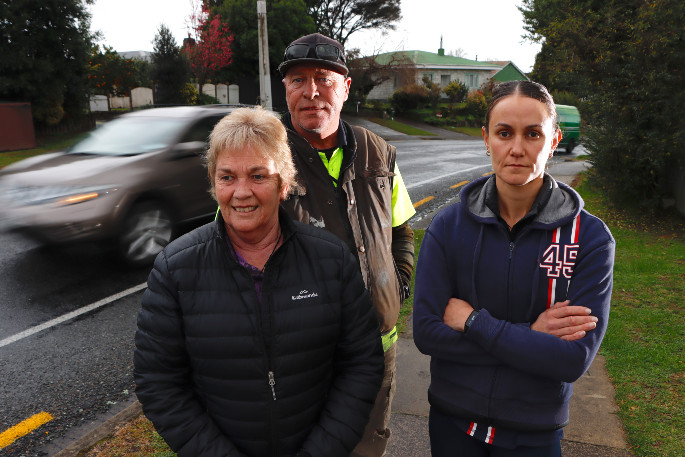 Boucher Ave neighbours Leeann Roestenburg, Steve Nicholson and Tara Jones. Photo: Daniel Hines/SunLive.
When a serious road crash has caused a death or life-changing injury, its impact is devastating and far-reaching, says a Victim Support spokesperson.
A traumatic event happens so unexpectedly and people's lives are disrupted as they try to make sense of what happened and find their way through the many consequences, says the Victim Support website.
"Shock, disbelief, and numbness are common first reactions when someone first hears the terrible news, was involved in the crash, or witnessed what happened or were at the scene following the crash."
Steve was doing work around his house with his teenage son on Saturday when they heard the noise of the crash and both ran to assist.
He says his son reached the road first, stopped and said to him 'No dad”.
Emergency services arrived to the gruesome scene and hours later finished their scene examination about 11pm.
During the evening, while the scene investigation was happening, Steve says 'a little kid came out of a driveway by the school at the playground”.
'He couldn't go down the road. He must have been wondering what had happened,” says Steve.
He was concerned that it would have been fairly easy for the child to skirt the scene down an alleyway and then peer at it up close over a fence, potentially also becoming exposed to the trauma.
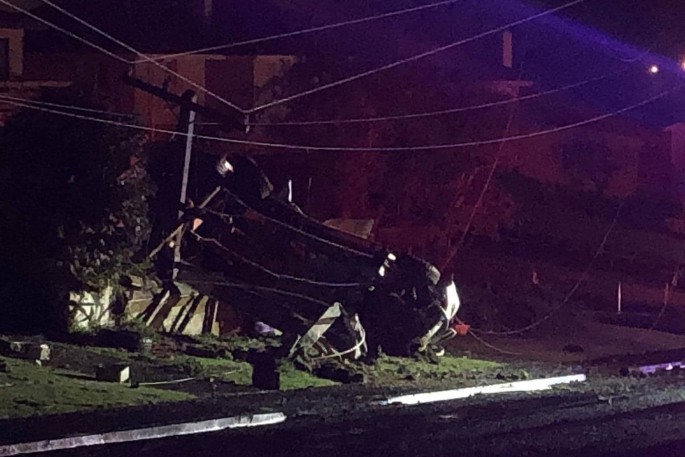 A crash occurred on Boucher Ave, Te Puke, in July 2020. Photo: Supplied.
Western Bay councillor Richard Crawford served with the Te Puke Fire Brigade for 13 years and has experienced what firefighters are confronted with at crash sites.
'As a past fireman, I understand the personal cost to turn up along with ambulance and police at scenes like this,” says Richard.
Western Bay of Plenty District Council senior transportation engineer Calum McLean says: 'We recognise that people will be affected in their own unique way to such events, and we encourage people to reach out to friends, family or other professional support services to help them through it."
'Council does not offer such services and given the nature of the event it is likely that NZ Police would take more of a lead in supporting victims, both direct and witnesses.”
Victim Support says everyone will react in their own way, but it's common for people to experience some strong reactions.
People often feel:
- it's hard to take in, understand, or believe what's happened
- horrified, helpless, and powerless – things feel out of control
- stunned, unable to feel anything, to think or speak
- concerned for the safety of others involved
- extreme anger - if it appears the crash was caused by someone else
- self-blame, guilt, angry at yourself – even if there was nothing you could have done
- blamed or judged by others
- pre-occupied with disturbing images and memories – real or imagined, troubled by nightmares or flashbacks, as if it were happening again
- you want to have more time alone, away from others
- anguish and anger by the senselessness of the crash
- distress and grief, either due to injury or the death of someone in the crash.
Many people also suffer physical reactions, such as a tight chest, a racing heart, shakiness, nausea, body aches, headaches, difficulty sleeping or changes in appetite, or crying.
Victim Support is a service offered by NZ Police for these types of scenarios. People can elect to self-refer if they feel affected by an event. More information on Victim Support relating to road accidents can be found here.
Brake's National Road Victim Service is a specialist service for people affected by road death and serious injury and the professionals supporting them.
Often, drivers behaving dangerously in communities are the same people who are living in those communities.
'It still comes down to people keeping to the road rules and speed limits,” says Richard.
Brake has a community campaign kit to help communities make streets in their area safer and to help prevent needless deaths and injuries.
Read more about the Speed Management Plan for Western Bay District Council here: www.westernbay.govt.nz/council/news-and-updates/news?item=id:2kcipnqu817q9shek80b
Click here for practical information on coping with trauma https://www.victimsupport.org.nz/practical-information/coping-grief-and-trauma/what-trauma
Click here for information on shock from crashes, road injuries and death https://victimsupport.org.nz/get-support/road-injuries-and-deaths/shock-crash

1 comment
More Traffic Police
Posted on 20-04-2023 15:23 | By oceans
New Zealand desparately needs many more traffic police on the roads, Motor Bikes, Marked cars and plain cars. AND the penalties for using a cell phone while driving and speeding need to be sustantially increased. Many, and I mean MANY people disregard the speed limits making them a danger on the road. I don't care about them, I care about all the innocent victims maimed, disabled or killed as a result of those drivers actions.
Leave a Comment
You must be logged in to make a comment.