


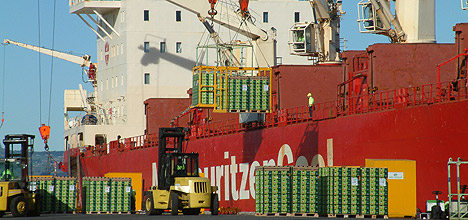
New Zealand kiwifruit is selling well and achieving good prices in international markets despite the depressed state of the world economy.
Zespri's general manager of grower and government relations Simon Limmer says despite the `headwinds' of the global financial crisis and the foreign exchange, performance in the markets is promising.
Kiwifruit is selling well in the overseas markets.
Volumes of the gold Hort16A fruit are down, due to the impacts of the vine disease Psa-V but Simon says marketers are pushing to keep prices up which has slowed sales slightly. However, that is not of concern as fruit quality and taste is good and he is confident of a `clean exit' from the market at the end of the selling season.
Prices for green fruit are also pleasing, including in Europe. The new gold varieties G9 and G3 are in the market in larger volumes that before and retailers and consumers are being educated about the new fruit which looks different and has a slightly different flavour to Hort 16A.
'The new varieties are being well received and we need to ensure we get consumer uptake because there will be a further increase in volumes next season.”
The markets are well aware of the impacts of the vine disease Psa-V because it now affected growers in most major production regions including Chile and Italy.
'However, as we know, Psa affects the vine and not the fruit and fruit quality has not been impacted.”
The biggest negative impact on grower returns is likely to be the strength of the New Zealand dollar and it is for this reason Zespri is working to achieve the best possible returns from the markets.
This is the last season New Zealand is likely to export significant volumes of Zespri Gold, also known as Hort16A, because most of the gold orchards in the Te Puke region have now removed infected vines and grafted to new varieties.
Those growers face one to two seasons of little or no income from their orchards while paying the costs of establishing the new varieties.
However, growers continue to produce Hort16A in other regions, including those as yet untouched by the disease. The variety has proved very susceptible to the disease and for that reason 2200 ha of orchard has been grafted to new varieties, much of it the new gold G3 which is believed to be more tolerant of the disease.
Meanwhile research continues into methods of controlling the disease and breeding varieties with even greater resistance. The industry has accepted it will now be impossible to eliminate Psa-V from New Zealand and that growers must find ways to manage it while continuing to produce export quality fruit.
The next four weeks will be stressful for the industry as they will reveal just how far the disease has spread, as vines coming out of winter dormancy show signs of infection.

0 comments
Leave a Comment
You must be logged in to make a comment.