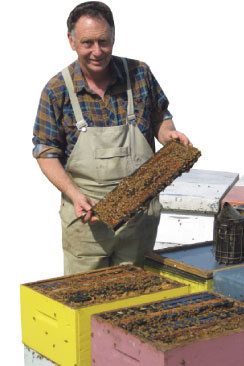
Neil Mossop extracting hive from one of Mossop's Honey's healthy, productive hives. |
There could be a shortage of pollination hives for kiwifruit this season because of the impacts of bee pests and diseases.
Neil Mossop of Mossop's Honey says the cold wet winter has been tough for many apiarists trying to keep their hives alive as they battle the impacts of varroa mite and Nosema ceranae, a microscopic parasite that infests the gut of bees.
'I have heard of some beekeepers who have lost almost all their hives this winter. The problem seems to be worse in Northland and is partly because the varroa mite has become resistant to the treatments used by some beekeepers to control the mite.”
Neil says the arrival of a new pest which affects the bee's digestive system is another blow for beekeepers and some are leaving the industry because it is becoming increasingly difficult and expensive to maintain healthy hives.
There will be fewer kiwifruit flowers to pollinate this season because around 2000 ha of orchard has been grafted to new varieties in the hope of helping the industry recover from the disease Psa-V but Neil says even so growers need to be making arrangements to secure hives early.
'Last season we had a number of growers ring us needing hives just before pollination because their beekeepers couldn't supply them.”
Hives will be going into Hort16A orchards from mid-October, followed by orchards growing the new variety G3 and by November green orchards will be in flower.
Mossop's is acutely aware of the impacts of the vine disease Psa on kiwifruit orchardists.
'Since Psa was first identified we have had a policy of not using hives in more than one orchard, so once they come out of an orchard, they don't go to another one in the same season. We also have bio-security protocols of spraying our vehicle tyres and our footwear when we leave orchards.”
Some growers prefer to have the hives dropped off outside the orchard and that can be arranged to. 'Our hives are on pallets so growers can move them into the orchard and even feed them with our safe and unique feeding system, so we do not have to enter the orchard at all.”
Most orchards have between eight and 10 hives per hectare but some have up to 12 hives, working on the basis that one hive will pollinate enough fruit to fill 1000 trays. While bees are excellent pollinators, Neil says in some orchards growers can supplement bee pollination with artificial pollination, especially in parts of the orchard which are colder.
However, he knows many growers are nervous about artificial pollination given that imported pollen may have been a way Psa was introduced into New Zealand. Since Psa was found there has been a dramatic decline in artificial pollination.
Mossop's were the first company in the world to supply beehives for commercial kiwifruit pollination when Neil took part in the pollination trial for the kiwifruit industry using 89 hives in 1972.
'We were paid $10 a hive back then.”




0 comments
Leave a Comment
You must be logged in to make a comment.