


AgITO together with industry partners DairyNZ is aiming to head off a major shortage in dairy industry management skills.
By restructuring its highly regarded Diploma in Agribusiness Management, enabling more people to complete it on terms that suit family and farm demands.
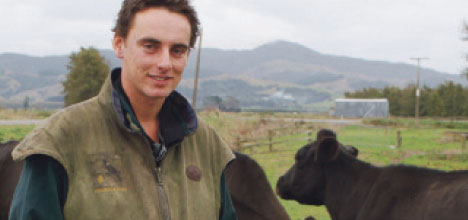
Matt Webb, variable order sharemilker and AgITO Diploma in Agribusiness management holder.
'We are looking at a need to have at least 1000 people in active management training for dairying. Across AgITO we have around 300, and in total including universities there are only 380 actively up-skilling to agribusiness management qualifications,” said AgITO CEO Kevin Bryant.
As the dairy industry pushes ahead to five million plus cows by 2020, a greater problem than creating the farms is finding the people with the skills to manage them.
In response AgITO has separated the diploma into specific modules which can be completed on their own or in combination, depending upon what suits the participant's skill needs.
'In the past anyone choosing the diploma would have to commit to completing two full national certificates and a property report, working progressively through them over two to three years,” says Kevin Bryant.
The new approach has accordingly won the approval of major industry bodies DairyNZ, Federated Farmers, Dairy Women's Network and NZ Young Farmers.
Research undertaken by AgITO has indicated there is significant interest among people at the right stages of their dairying careers to complete the diploma.
However sheer time demands meant this was not always possible, with many also running busy farm operations, juggling family commitments and the usual business paperwork.
'This was particularly noticeable amongst women who were often dealing with all aspects of farm and family, but are particularly keen to up-skill themselves at the same time,” said Kevin.
The diploma itself has not changed, retaining its well-regarded key learning components. However the modular approach now recognises the different stages people can be at when they want to pick up specific skills within the diploma.
The five module breakdown covers key aspects of running a successful agribusiness operation, including human resources, financial planning, taxation, ownership and risk assessment, resource management and a property report.
'For example a herd manager may want to move up to management, but knows he needs to up-skill in human resource management. For a lower order sharemilker, they may be comfortable with HR, but know they need to have better financial planning and tax skills to get the most out of their current position, or to move to their next role.”
Dairy operators who have completed the diploma testify to the skills they have learned, and the immediate value those skills deliver to their farm businesses.
Piako contract milker Matt Webb attributes the understanding he gained about tax management in the diploma's taxation/investment module to delivering a 'no surprises” tax bill this year.
Under the ownership-risk management module he also learned to closely assess the twin risks of pay-out volatility and production uncertainty in the dry-prone Hauraki Plains region.
'You cannot change what the pay-out will be, but you can smooth out the income through the year to balance those unknowns of production and pay-out.”
DairyNZ strategy manager Mark Paine says the modular nature of the AgITO Diploma captures all of the strengths in AgITO learning.
'We get strong feedback from students that they value the sense of community they experience on those courses. The modules mean you can still participate in a group learning environment, without having to step out of your farming career to do so.”
DairyNZ also valued the high degree of relevance the diploma has to candidate's businesses.
Kevin Bryant believes the new structure will open up the diploma to many in the industry who know they need more skills, but struggle to find the time to up-skill.
To learn more about the AgITO National Diploma in Agribusiness Management, contact www.agito.ac.nz

0 comments
Leave a Comment
You must be logged in to make a comment.