


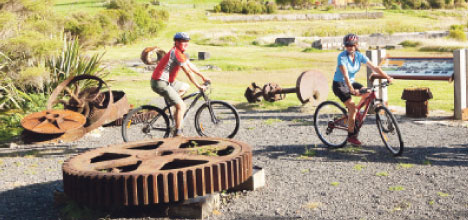
Cyclists are spinning the wheels of commerce in what is being hailed as an environmentally and economically sustainable development to breathe new life into the Hauraki, Thames-Coromandel and Matamata-Piako districts.
In the four months since the Hauraki Rail Trail opened Hauraki District Council Mayor John Tregidga says it has already exceeded predictions.
'The number of cyclists on the trail during winter has been more than we expected and we anticipate even bigger numbers during the summer.
'We will need at least another 250 beds in the districts in the next three years to meet demand for accommodation and that will include everything from backpacker and homestays through to top end accommodation,” John says.
So far around 60 kilometres of the trail, including 54 bridges, have been constructed from Kopu to Waikino, with a further section to be formed from Thames to Kopu. However, the trail nearly didn't happen.
John says initially the route, much of it following old railway corridors, was chosen by the Government to be one of seven ‘quick start' trails around New Zealand with a promise of $10 million in funding.
'However, the funding was cut, putting the project in doubt.
'When I looked at the economic benefits it could bring to our districts, I knew it had to go ahead.”
In the end the Government invested $4 million into the trail, and the rest was funded by a partnership between the Hauraki, Matamata-Piako and Thames-Coromandel councils and the Department of Conservation.
'There was some initial opposition from ratepayers, including one woman who was particularly upset. However, someone took her on a bike ride and she came into my office to apologise and say what a wonderful asset it was.”
John says once the Thames section is complete the trail will be a three-day, two-night experience along a grade 1 route which is ideal for bikers of all ages and levels of fitness, plus walkers, wheelchairs and pushchairs. However, as access to the trail has been designed to prevent horses and motorbikes using it, special arrangements need to be made for wheelchairs and recumbent bikes to gain access.
It was Mark Barnett of Queenstown who carried out the economic feasibility study on the trail and he was so impressed with its potential, he tendered for and gained the contract for its management.
'I could see from the start what the potential was. Around 50 per cent of New Zealand's population lives with a two-hour drive of the cycle trail. The majority of people who ride the Otago Rail Trail are from the North Island, so there is obviously an appetite for it.”
Mark believes the trail will help sustain small rural towns which could otherwise suffer from dwindling populations and centralisation of rural-based companies such as freezing works and dairy companies, and do so with a minimum of environmental impact.
'Already this winter businesses along the route are reporting increases in turnover of up to 70 per cent in some cases. This will only grow in summer. We already have advance bookings for October, November and December.”
He predicts the majority of riders will be New Zealanders, with around 20 per cent overseas tourists. Cycling holidays are a worldwide trend and New Zealand is lagging behind other countries in making provision for them.
'Biking is a lifestyle thing. It's about health and family and friends and doing something enjoyable in the outdoors.”
There's no charge for using the trail but it is possible to book guided tours, hire bikes and arrange to be dropped off and picked up at any point along the route. To find out more, go to: http://www.haurakirailtrail.co.nz
Hauraki Rail Trail:
• Kopu to Paeroa – 27km
• Paeroa to Waikino – 14km
• Paeroa to Te Aroha – 20km
• Smooth gravel surface, approximately 2.5m wide
• Trail through farmland fenced on both sides
• Bridges are 1.5m wide

0 comments
Leave a Comment
You must be logged in to make a comment.