


One day in 2020 Gratten Layne went to work and never came home – becoming one of 435 workplace fatalities in New Zealand over the past decade.
Layne was fatally crushed between his truck and a loader in north Waikato, and his employer wasn't prosecuted after agreeing to spend about $1 million on boosting safety and reparations.
And the number of WorkSafe prosecutions over workplace deaths is much lower than the toll. In the past 10 years it has launched 165 prosecutions, succeeding with 125.
The Government believes that shows good decisions about what action to take but a union leader says that's 'no consolation for the other two thirds of families who have lost loved ones”.
Stuff have revealed how many workplace deaths have happened in New Zealand, and how many prosecutions and 'enforceable actions” have been undertaken by the country's workplace health and safety regulator thanks to an Official Information Act request.
WorkSafe data shows December 2019 was the deadliest month by far for workers, with 27 fatalities.
By comparison, the second-deadliest month – February 2019 – saw 11 deaths.
They were the only two months in the decade with a workplace death toll in the double digits.
WorkSafe launched 11 workplace death prosecutions in 2019, succeeding with 10 of them.
Last year saw the most prosecutions launched at 32, with 2016 seeing the second-most prosecutions with 24.
The highest number of successful prosecutions were last year and 2016 at 22 each, followed by 2014 and 2015 with 14 successful prosecutions.
But it doesn't always go that route – as was the case with Layne's death.
After the 60-year-old truck driver was struck at the Hampton Downs EnviroWaste landfill site, the company agreed to a legally-binding 'enforceable undertaking”.
WorkSafe has entered into 41 such 'accepted enforceable undertakings” over the past decade, an agreement between WorkSafe and a duty holder made under the Health and Safety at Work Act 2015 (HSWA).
It is entered into voluntarily by the duty holder following a breach (including an alleged breach) of the act.
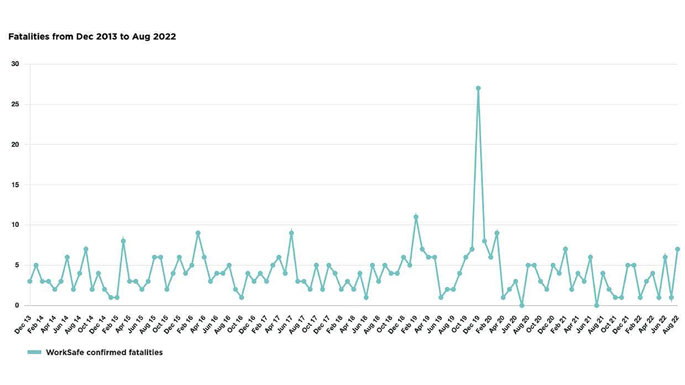 A WorkSafe graph showing workplace fatalities from December 2013 to August 2022. In total 435 fatalities were recorded, with the worst month December 2019 and 27 deaths. Photo: Stuff/Supplied.
In the EnviroWaste case, WorkSafe documentation showed the company had a previous conviction from an incident in 2015 where a worker died after being trapped in a glass recycling mechanism on a truck. It had enforcement actions between 2007 and 2020 at six locations across the country.
In the wake of Layne's death WorkSafe said that, instead of prosecution, it had accepted an enforceable undertaking, with the overall agreement coming at a 'minimum cost of nearly $1 million” to the company.
The minister responsible for WorkSafe, Michael Wood, declined to comment to Stuff, but a spokesperson says WorkSafe has succeeded in 75 per cent of the prosecutions it has launched.
'WorkSafe has also carried out more than 1500 investigations,” they say.
The spokesperson says Government has invested additional resources into the regulator 'to ensure it can continue to respond, investigate and help prevent workplace harm and injuries”.
They also say their rate of success for prosecutions 'shows we are making good decisions when we prosecute”.
'There are a range of reasons why a fatality may not proceed to prosecution including the Solicitor General's prosecution guidelines.
'Investigations and prosecutions are only one way of addressing work harm. They are effective but other actions may be available to WorkSafe that have a different impact.
'Other enforcement options available under the Health and Safety at Work Act 2015 include improvement and prohibition notices, audits, regulatory conversations, reactive targeted assessments and enforceable undertakings.”
National party workplace relations and safety spokesperson Paul Goldsmith MP says any workplace death is a tragedy, and takes aim at what he says is a lack of prosecutions.
'The striking thing is that all the effort since the establishment of Worksafe, across all of New Zealand, has led to only modest improvements in terms of workplace deaths. It raises the question, have we got our focus on the right areas?”
'The statistics generally show that Worksafe has not been particularly active in prosecutions. Their budget has increased by 50 per cent since 2017, but they are undertaking fewer prosecutions.”
First Union general secretary Dennis Maga told Stuff that 'every workplace fatality is one too many”.
'All deaths at work should be avoidable and under health and safety legislation, employers have a responsibility to manage risks in a way that protects their workforce,” he says.
'Maintaining a workplace where workers feel safe is something that every company should work towards.”
Maga says that, in absolute terms, the number of workplace deaths 'has barely moved over the last decade”.
'However, the workforce is now significantly larger, indicating a declining rate of workplace fatalities, which is a good thing. But there is still a lot left to be done to continue reducing that number.”
He says the OIA data indicated roughly one in three workplace deaths result in a prosecution, but that is 'no consolation for the other two thirds of families who have lost loved ones in the last decade”.
'Prosecutions can't undo an accident, but they serve a vital role in setting precedents for future workplace safety standards.”
Maga also says new legislation expected in the next year will limit a business's ability to decline elections for workplace health and safety representatives or establish committees, which will go some way to ensuring greater oversight of risks in the workplace.
'Additionally, there's a case to consider in terms of industrial manslaughter legislation as it's used in Australia, where workplace deaths will result in a mandatory prison sentence for employers or any person conducting a business or undertaking whose actions or omissions led to a death at work.”

0 comments
Leave a Comment
You must be logged in to make a comment.