


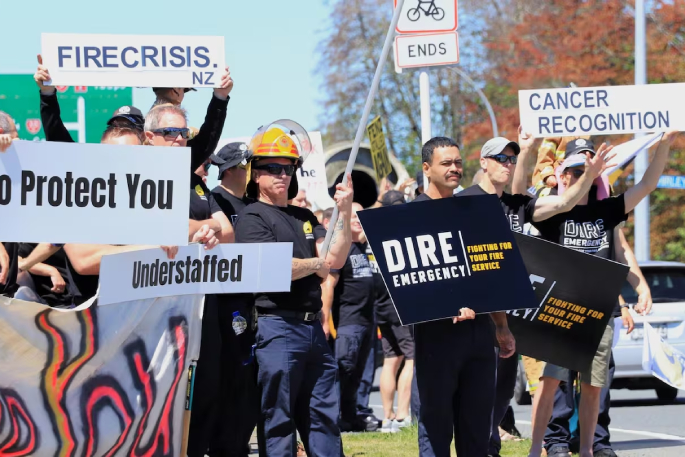
Paid firefighters across the Bay of Plenty will strike for 10 hours this month for better pay and resourcing – which Fire and Emergency New Zealand says could have “fatal consequences”.
But the New Zealand Professional Firefighters Union says Fire and Emergency puts public safety at risk with understaffing and inadequate resourcing of its fire crews.
The union will escalate its twice-weekly, one-hour strikes to four 10-hour strikes beginning on November 27. Bay firefighters marked their 50th strike on July 31.
Nationwide strikes began on August 19, 2022, over pay, working conditions and resourcing.
The Bay of Plenty has paid firefighters in Greerton, Mount Maunganui, Tauranga, Taupō, Rotorua and Kawerau fire stations.
Rotorua union secretary Geni Walters said Rotorua had 53 union members. Of Tauranga’s 70 union members, 24 had confirmed they would be striking.
Tauranga union secretary Mike Swanson said strike plans were still in progress, but would likely be based at Tauranga Fire Station and involve a march through the city centre.
“It’s frustrating when we hear in the media that we, as union members, are putting the public at risk by going on strike for 10 hours.
”What the public doesn’t realise is every weekend in the Bay of Plenty, one of our stations is closed for 10 hours nearly every weekend because of the lack of staff.”
A Fire and Emergency spokesperson said it was not true to say a Bay of Plenty career fire station was off the run every weekend and all calls to 111 would be responded to.
Swanson said the union was trying to make firefighting safer in the long run. In his opinion, further cuts would “degrade” the service and render it “ineffective”.

Steve Tweed (left) and Paul Arrowsmith at a Tauranga firefighters' strike in 2025. Photo / Bijou Johnson
He said Fire and Emergency had offered a 2.2% pay increase, which the union had rejected.
Swanson said the union wants to address “the complete package”.
“We want to sit down with them and work out how they’re going to address safe staffing, how they’re going to address safe and appropriate vehicles, how they’re going to address a number of different things, and then we can look at that as a package and allocate funds to each of those.”
He said the strikes could be “called off at any time” if Fire and Emergency and Government ministers “sit around the table with us and work this out”.
“You’ll never find a firefighter that wants to go on strike. We hate the idea of doing it, but it’s the only way that we can bring attention to the plight we’re in.”
Union national secretary Wattie Watson said the strikes were needed because Fire and Emergency (Fenz) was putting the public’s safety and welfare at “increased and avoidable risk”.
“Seldom does Fenz meet minimum staffing requirements in the 111 emergency dispatch centres, and it is not unusual for one of the three emergency dispatch centres to be closed due to lack of staffing.”

NZ Professional Firefighters Union members Mark O'Connor (left) and Josh Neilson strike in Rotorua in 2025. Photo / Ben Fraser
She said union members “overwhelmingly” voted for four 10-hour strikes.
Watson said the strikes would be from 1pm to 11pm, affecting day and night shifts, including firefighters, 111 emergency dispatchers, volunteer support officers, trainers and those working in risk reduction.
Fire and Emergency New Zealand responds
Fire and Emergency New Zealand national commander Megan Stiffler said most Bay of Plenty firefighting brigades were volunteer-run, and contingency arrangements for the strikes were being prepared.
However, she said the strikes would create “extreme risk” to public safety.
“These strikes could have fatal consequences. We will do everything practically possible to protect the public, but there are significant gaps in the emergency response we can provide that simply cannot be filled.”
She said Fire and Emergency was also working with the Government to assist with the broader impacts.
“Fire and Emergency respects the right to lawful industrial action. However, paid firefighters walking off the job for 10 hours at a time is a significant and avoidable risk to our communities.”
Stiffler said available volunteers would respond to incidents.
However, she said they were further away and could not replicate the specialist skills, equipment or coverage of paid firefighters.
“We will do everything practically possible to protect the public, but there are significant gaps in the emergency response we can provide that simply cannot be filled.”

Tauranga career firefighters walked off the job for the 50th time on July 31. Photo / Sandra Conchie
Stiffler said Fire and Emergency had called on union leadership to reconsider the strikes.
“The Employment Relations Authority should call an urgent facilitation to get parties back around the bargaining table and use all available means to deliver an outcome, including publishing recommended terms for a settlement.”
She said Fire and Emergency remained committed to achieving a fair and sustainable settlement.
Emergency services make contingency plans
Other services are preparing contingency plans for response delays and executing firefighting duties such as motor vehicle rescues.
Police deployment director Superintendent Iain Chapman said police had been notified of the strike and were working with Fire and Emergency on a Government-wide response.
Hato Hone St John ambulance operations deputy chief executive Dan Ohs said impacts on ambulance services were being assessed.
He said focus areas were ensuring a quick approach for patients needing CPR and saving patients trapped in motor vehicles.
KiwiRail was working on contingency plans with Fire and Emergency New Zealand and Government agencies, according to a spokesperson.
The spokesperson said there was currently no impact on services.
Bijou Johnson is a journalist based in the Bay of Plenty. She grew up in Tauranga and joined NZME in 2025 after studying communications at university. She holds a Bachelor of Arts in Classical Studies from Massey University.

0 comments
Leave a Comment
You must be logged in to make a comment.