


The kiwifruit industry is welcoming news that the Ministry for Primary Industries is making progress to improve its biosecurity procedures, based on the recommendations of an independent reviews sparked by the outbreak of the vine disease Psa-V in New Zealand.
Director-General Wayne McNee says that the Ministry has now completed the 10 actions set to be carried out by the end of August 2012 but two significant kiwifruit industry organisations say they haven't been consulted about what is being implemented.
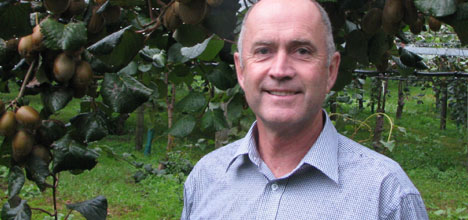
Barry O'Neil from Kiwifruit Vine Health.
President of New Zealand Kiwifruit Growers Inc Neil Trebilco says he is looking forward to learning what the ministry has put in place.
'We haven't seen anything yet but have been told we will be consulted. We want to have input into preparedness both pre-border and at the border and are looking forward to that.”
Neil says NZKGI has signed a memorandum of understanding so it can be involved in the discussion around the proposed Government Industry Agreement (GIA) for biosecurity preparedness.
The GIA aims to give primary producers an equal say in the decision-making process around biosecurity preparedness and incursion response but may also require affected industries to cover some of the costs involved in an incursion.
Kiwifruit Vine Health chief executive Barry O'Neil says he is pleased the ministry is making progress in implementing the recommendations of the Sapere Report.
'KVH has written to the Director General asking that KVH be in involved in future input into proposals relating to the Saprere Report, but we have not so far had direct contact with the ministry in respect to the recommendations in the report.”
KVH chairman Peter McBride and Barry are to meet with the ministry on September 10 to discuss the implementation of the report's recommendations and to ensure the kiwifruit industry is adequately represented and engaged in future risk management.
They will also meet with the Minister for Primary Industries David Carter to discuss the proposal to implement a National Pest Strategy for the kiwifruit industry, which would increase its powers to act over outbreaks of pests and diseases.
Today was the last chance growers had to vote on the establishment of the policy and both Neil and Barry say they are hoping for a strong majority to demonstrate to the Minister the industry's support for such a proposal.
The Sapere report the ministry is now acting on was commissioned in February by Wayne McNee.
'In commissioning the report, I wanted assurance that the ministry is doing absolutely everything it can to manage biosecurity risk around products imported to New Zealand. If there were improvements to be made, I wanted to identify and implement them.”
The review report made six recommendations, five of which focused on improving systems at the ministry. MPI accepted all six recommendations and identified 16 specific actions to implement these recommendations.
'In addition to the 10 actions we have completed, four of the remaining tasks have been started and I can confirm all have been initiated and partially completed. They are on track for delivery by the specified dates in 2012 and 2013.”
The remaining two actions have longer time frames as they involve the creation of IT tools to establish information sharing with other agencies.
Five of the six recommendations by the independent reviewers proposed changes to processes and procedures to better identify, study and manage biosecurity risks around the border. The report's first recommendation is, however, different.
'This recommendation suggests the ministry consider reprioritising its resources to better manage the risks to economically significant industries.”
'MPI's decision-making and prioritisation processes include the consideration of a range of factors, including the costs and benefits of actions to protect primary industries, the natural environment and human, health and cultural values.
'As our existing assessments already recognise the scale of industries and their potential biosecurity risks, we believe the current MPI processes already deliver significant benefit to the higher value industries. However, in line with Government priorities and the Ministry's Strategy 2030, the relative weighting of resourcing toward economic outcomes has been increased."
The recommendations, the actions to address those recommendations and the progress made is in a Management Action Plan progress report available at: http://www.biosecurity.govt.nz/files/pests/psa/progress-update-psa-management-action-plan.pdf

0 comments
Leave a Comment
You must be logged in to make a comment.