


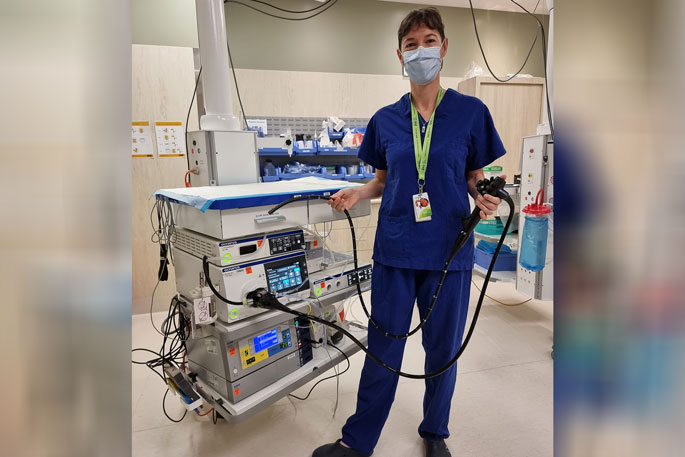
The completion of a new Procedures Room will help further strengthen Bay of Plenty's colonoscopy programme and is another step forward in the ongoing fight against bowel cancer.
The facility, at Whakatāne Hospital, is scheduled for completion by the end of December and will add capacity to enable more colonoscopy, endoscopy and other light surgical procedures to be carried out.
Work on the procedure room, which is located within the existing Surgical Admissions Unit, began in May and is on track, with the important milestone of medical gas connection achieved last week.
It is good news for Eastern Bay residents, many of whom will be able to enjoy care closer to home as a result.
The facility also represents another significant step forward for the Bay's colonoscopy programme which, due to service improvements, has seen patient waiting times for surveillance colonoscopies drop significantly over the last 12 months.
'This is something of which the teams involved can be proud,” says Te Whatu Ora Hauora a Toi Interim District Director Pete Chandler.
'The new Procedures Room at Whakatāne Hospital is indicative of our commitment in the fight against bowel cancer, and it will undoubtedly prove a huge asset. It adds more capacity for procedures to be undertaken such as surveillance colonoscopies. It will help us reduce procedure waiting times for those communities we serve.
'I'm proud of the significant improvements in waiting times that the service has achieved in recent months.
'Improving our colonoscopy waiting times has been our highest performance improvement priority over the past two years. Even with the immense disruption of Covid-19, our clinical, management and admin teams have worked together to deliver an amazing achievement.
'Our hardworking teams last year conducted nearly 5,000 colonoscopies (urgent, non-urgent and surveillance), averaging around 90 per week,” says Pete.
The national target for surveillance colonoscopies is for patients to be seen within 84 days of their repeat colonoscopy being required.
Due to recent improvements the average number of days patients now wait for a surveillance colonoscopy in the Bay of Plenty has fallen to 58 days.
Pete urges residents to play their part in protecting their own health.
There are more than 44,000 Bay men and women aged 60-74 who will be eligible for the free programme.
Te Whatu Ora Hauora a Toi National Bowel Screening Programme Clinical Lead Dr Alex Lampen-Smith urges people who become eligible, to get tested.
'It's a potential lifesaver.
'New Zealand has one of the highest rates of bowel cancer in the world and bowel cancer is the second-highest cause of cancer death across the country. Each year over 3000 people are diagnosed with bowel cancer and more than 1200 people die from it. But if found early, it can often be treated successfully.
'The programme seeks to identify people who are at risk of bowel cancer before they develop symptoms and provide treatment and ongoing screening.”
Latest figures show that from more than 7000 tests returned in the Bay of Plenty, 204 follow-up colonoscopies have been performed and 12 cancers have been detected.
As well as detecting bowel cancer, a colonoscopy, will also remove growths in the bowel (polyps), which may become cancerous over time alongside providing ongoing surveillance for people at high risk of bowel cancer.
The National Bowel Screening Programme receives information around eligible people who are enrolled with a GP – when it is a person's turn to be screened, they receive an invitation letter, a consent form, and a free bowel screening kit.
The free test is quick and is designed to easily and cleanly take a sample (which people do for themselves at home).
Once the sample is in the kit, it needs to be posted back in the pre-paid envelope as soon as possible - samples need to be in the laboratory for testing within seven days of it being completed.
If the test is negative, participants and their GP will be sent a letter with the results of that test. Nothing further needs to be done until it's time to do the kit again in two years.
If the test is positive, the participant's GP will be in contact to arrange a free appointment to discuss the results and the next steps.

0 comments
Leave a Comment
You must be logged in to make a comment.