


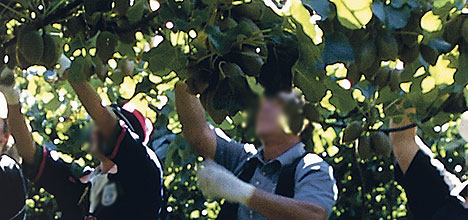
The intentions of educational institutes bringing foreign students to New Zealand, some of whom are working illegally in the kiwifruit industry, is being questioned by Horticulture New Zealand.
HortNZ chief executive Peter Silcock says it is of concern that some students may be working illegally for low wages and believes the role of their education providers needs investigation.
'We certainly question the intentions of some of the education institutes that bring these people to New Zealand and we think that needs to be looked at. Our growers who bring people out under the Registered Seasonal Employer scheme need to be registered and face high compliance hurdles. Do education institutes face the same process?
'Everyone recognises the problem. The very difficult part is assessing the size of the problem and addressing it, because this is a labour market working almost entirely out of view of the rest of the community.”
The issue of foreign student workers was raised in a study released by Danae Anderson, Suzanne Jamieson and Krish Naidu of AUT Auckland and Sydney University in July this year.
The research found the 93 students surveyed were being paid $8-$11 - below the minimum wage rate which was set at $12.75 at the time.
A number of the students also had to repay loans for their education fees and/or travel costs, pay remittances and needed additional money to support t heir education and living costs.
Slightly more than a quarter of students (26 per cent) sought work experience directly relating to their area of study and a further 21 per cent worked part-time primarily to gain general work experience.
In spite of the low pay, horticulture in general paid better than other work in the service and hospitality sectors. It was also more consistent which meant students were assured of regular, extended hours.
The report states that some workers believed contractors were benefiting by quoting a higher hourly rate than they were paying workers and pocketing the difference.
Peter says it is often difficult for growers to get accurate information from contractors.
'The industry supported the establishment of the Master Contractors Association a few years ago to help industry employers understand what is required of a good contractor service.
'HortNZ already works in the key horticulture growing regions to encourage the use of the Master Contractors Association, and we work with the regional labour governance groups and the local government agencies concerned to find ways to discourage bad employment practices.”
The report claims there are people working under irregular and unprotected conditions in horticulture and Peter says the industry in New Zealand has done a huge amount of work to improve its employment attractiveness in the last 10 years.
'This type of behaviour occurs in every workforce, everywhere around the world. New Zealand is no different.”
He disputes the report's suggestion that the willingness of migrants to work in substandard conditions and for lower wages may be taking work away from New Zealanders.
'The study makes this claim but it is difficult to assess how valid it is. International students are permitted to work. We do not think it is significant. If local workers want work in the industry there are still a lot of jobs available at the peak of the season.”
The study also questioned whether the use of student migrant labour was a necessary strategy in the Bay of Plenty region.
'No. These illegal workers are not a necessary part of the Bay of Plenty workforce. There are a number of schemes in place to provide legal staff,” says Peter.
He says the issue is one for the wider community to take responsibility for.
'This needs to be led by the appropriate government agencies. We need greater levels of enforcement work both with education institutes and contractors.”

1 comment
'Legal' staff enjoy the dole too much
Posted on 25-08-2012 18:13 | By wreck1080
While we have such a generous social welfare system unemployed bay workers will be too lazy to get these jobs.
Leave a Comment
You must be logged in to make a comment.