


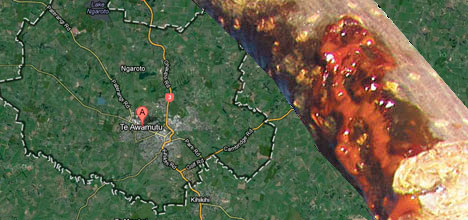
The kiwifruit vine disease Psa-V has been confirmed in two Te Awamutu orchards and a controlled movement area and bio-security measures have been set up in a 12km radius of the properties, affecting 26 other orchards.
Kiwifruit Vine Health chief executive Barry O' Neil says because of the location of the orchards it is unlikely the disease is wind borne, but while attempts are being made to trace the source of the infection, it may never be conclusively identified.
Psa has been discovered in two orchards in Te Awamutu.
One of the infected orchards grows fruit organically and its neighbour uses conventional management techniques.
Barry says it is disappointing that Psa has been found in an area previously thought to be free of the disease, but this serves to highlight the fact that no one can be relaxed about bio-security and management practices to protect their vines.
The organic orchard has 3.3ha of Hort16A while the neighbour has half a hectare of the highly susceptible gold vines. Both orchards also grow green kiwifruit, which are also being tested to see if they have the disease.
Barry says based on the Te Puke experience, the best option for growers is to remove all the Hort16A vines.
'We can't force the growers to remove the vines but we are working closely with them to achieve the best outcome we can. The case study done in Te Puke last season of 57 infected Hort16A orchards showed that only six got to production and those vines had a yield which was 30 per cent down on the year before.”
Should the growers decide to cut out the vines now, Barry says KVH will work with Zespri to secure budwood for the new and more tolerant gold variety G3 to graft in their place.
'We still have 50 per cent of the land growing kiwifruit in New Zealand free of Psa and we need to do what we can to keep it that way. This discovery reinforces the need for the National Pest Management Plan (NPMP), which is currently the subject of a grower poll.”
A recent economic impact report estimates that Psa will cost the kiwifruit industry between $310m-$410m in the next five years; $500m-$600m in the next ten years; and $740m-$885m over the next 15 years. The effect on regional economies and related businesses will push the total cost of Psa much higher.
The two Waikato cases of Psa were reported on Friday, August 17 and confirmed on Monday. As at August 16, 17 other new cases of Psa-V had been identified, two in the Waihi; three in the Katikati; three in Tauranga East; three in Te Puke, three in the Whakatane and four in Opotiki.
That brings the total number of orchards infected to 1262, representing 47 per cent of the country's hectares planted in kiwifruit.
Barry says the key elements of the NPMP will be to enable on-orchard hygiene and application of movement controls to manage the risks of spread to uninfected orchards and areas.
The plan will ensure diseased orchards are being actively managed to lower the inoculum levels in the area.
Growers will be able to apply the approach that is best suited to their production system and KVH will continue to develop and provide best practice advice for control.
However, if a grower is not actively managing a diseased orchard, and as a result high inoculum levels are creating a significant risk to others, the grower will be required to change their approach.
Growers are being asked to vote on the proposal and the poll closes on August 31.
Following the poll a formal proposal will be prepared and forwarded to the Minister for Primary Industries for approval. The minister must be satisfied the proposed NPMP has broad grower support before endorsement.

0 comments
Leave a Comment
You must be logged in to make a comment.