


The disease Psa-V is appearing in the new gold variety G3 and established green kiwifruit earlier than last season and while not completely unexpected the industry is watching anxiously to see how vines hold out against it.
CEO of Seeka Kiwifruit Industries Michael Franks says while it is unclear whether the symptoms in both newly grafted and more mature G3 vines will progress, their appearance is worrying.
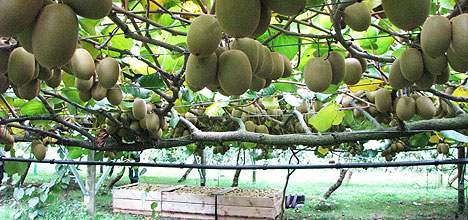
The new kiwifruit variety G3 is showing symptoms of the vine disease Psa in both newly grafted and more mature vines like these ones pictured just before harvest this year.
'I think it is significant that we are seeing this level of infection this early. Whether or not that turns out to be a bigger problem, we can only wait and see. What we have seen so far is unwelcome.”
Zespri has released licenses for 2274 hectares of the G3 cultivar to orchardists who have grafted the new variety this winter. G3, to be marketed as SunGold, had proved to be more tolerant to Psa than the original gold fruit Hort16A but Zespri has consistently said it is still susceptible to the disease.
Michael has made a statement to the NZX, saying that orchard monitoring over the last week had detected more symptoms of Psa in green Hayward plants and further symptoms in G3. As a publically listed company Seeka is required to regularly update the market on any event which may have an effect on its share price.
As the vines come out of their more dormant winter state, signs of the disease have been found on orchards in Te Puke Paengaroa, Otamarakau and Maketu and symptoms are also evident in green Hayward males and female vines at Oropi.
'Sap moves in plants more during the lunar cycle and we had a full moon just a few weeks ago. Almost immediately after that the symptoms were noticed.
'We will know more in the next couple of weeks but I am not taking too negative a view at this stage.”
Michael says seeing the disease in the new variety is a blow to growers but they always knew G3 was not immune.
'Growers are resilient but this disease has been hard on them for a long time now. 'The Te Puke community is very supportive of the industry and growers are supporting each other.”
Chief executive of Kiwifruit Vine Health Barry O'Neil says in Opotiki Psa symptoms were seen in both new variety and Hayward green around two weeks earlier than last year.
It was not unexpected that juvenile new variety vines should show signs of the disease as they were not able to project themselves as well as more mature vines.
'Growers who are most affected appear to be those with orchards in frost-prone gullies or wet or exposed areas. Some have also not maintained crop protection practices sufficiently to manage Psa and a small percentage has carried out hard girdling, often with a knife which is not recommended.”
Girdling with chains, which are disinfected between vines is an acceptable method of encouraging increased crop yield.
'So far we have reports of 61 cases of secondary Psa symptoms in mainly male Hayward vines in the Bay of Plenty, mostly in the Te Puke, Tauranga, Whakatane, Opotiki and Waihi areas.”
However, Barry says the true number is probably far higher as two packhouse, which surveyed all their growers found secondary symptoms on 50 per cent of the orchards.
'Last year we saw Chieftain and M Series males with secondary symptoms which went on to recover, flower and be successful pollinators.”
As the vines currently have no leaves, those which are infected are showing red ooze or cankers. Barry says growers who have a small number of vines with cankers or red ooze are advised consider cutting the leader out or drilling out the canker and cauterising the wound with a butane burner and applying a wound sealant. If more than 50 per cent of vines are infected the advice is to use copper sprays.
Barry says removing infected males completely is not being suggested because they are needed to pollinate female flowers to produce fruit for next season.
'At the moment the management options open to growers are limited to copper. We are awaiting Ministry for Primary Industries approval to use KeyStrepto (an antibiotic). Elicitors and biological controls can also be used now.”
Experience in Italy showed that green growers who actively managed their orchards were less impacted by the disease than those who did nothing.

3 comments
THE DOORS
Posted on 16-08-2012 18:23 | By YOGI
This is the end ... Well no surprises there, the Italians are still seeing vines die from PSA and the expectation is that all will die eventually, the more that do die means that less chance of wind blown infection so the few that remain can possible survive by chance. Looks like Zespri need to refund the dollars extracted for a false hope of something immune.
Here we go again it seems
Posted on 17-08-2012 08:49 | By RORTSCAM
This is very scary stuff and really worrying at such an early stage particularly as Spring isn't here yet.Question is what were new G3 plants grafted on to not existing Gold vines one would hope.
YEAH RIGHT
Posted on 17-08-2012 09:23 | By lurking
large scale reduction of the executives and academics at head office.Salary reductions.no bonuses for zespri staff this year
Leave a Comment
You must be logged in to make a comment.