


The grafting of more than 2000 hectares of kiwifruit vines to new varieties this winter will result in a drop in crop volumes, but as those new cultivars come into production, there will be a dramatic lift in volumes, Zespri chairman John Loughlin told the marketer's annual meeting on Wednesday July 18.
'We should not underestimate the magnitude of change the industry faces from a successful delivery of the recovery pathway. At very short notice there is likely to be a complete swing from declining volumes to rapidly increasing volumes.”
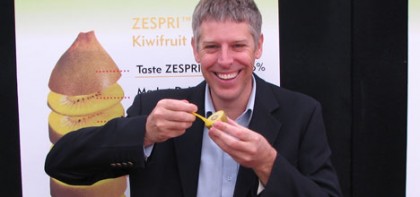
Lain Jager, Zespri CEO, samples Gold3 the new variety the industry is pinning its hopes on.
Managing reduced volumes and incomes while retaining capacity to cope with a significant increase will challenge Zespri and the post-harvest sector.
'Zespri faces a huge challenge in the timing and prioritising of our part in the recovery pathway. We do not have the resources to move too early and at the same time the industry cannot afford us moving too late.”
To cope with falling volumes and revenue in the coming season, John said Zespri had cut costs by $7 million, but that figure was less than it had originally signalled.
'It reflects a decision made by the board to commit to a number of investments to advance strategic initiatives that will maximize the ability of the industry to capture the benefits in the market of a successful execution of the Psa recovery pathway.”
That pathway takes the form of more than 2000 hectares of Gold3 being grafted this winter. Of those hectares, 1750 are by current Hort16A growers transitioning to the new gold and in addition, 560 green growers will also graft 350 hectares of their orchards to Gold3.
Despite the potential for Gold3 to achieve significant volumes in a relatively short time, it is not without its risks, he said.
'Gold3 must be seen for what it is – the cornerstone of a potential recovery pathway. We have learned that there is no future in a Psa environment without tolerant cultivars. In Italy, we have also observed on Hayward that tolerance alone is not sufficient. Cultivar tolerance must be supported by attentive and active management.
'We have a pathway where the risk is material and without an unrelenting focus on managing orchards to minimise Psa risk there will be growers who do not successfully make the transition to Gold3.”
In recognition of the on-going threat Psa poses, the board had committed to heavy investment in the Psa research and development programme.
'Quality execution from Zespri will be required in order for growers to receive the full benefit of their efforts of successfully establishing the recovery pathway on their orchards.”

0 comments
Leave a Comment
You must be logged in to make a comment.