


Kiwifruit growers have been arriving at a Tauranga facility to collect their quota of more than two million pieces of budwood to be grafted onto vines this winter in the biggest transition to a new variety the kiwifruit industry has experienced.
Teams are working to remove existing vines and replace them with the young graft wood in orchards throughout the district.
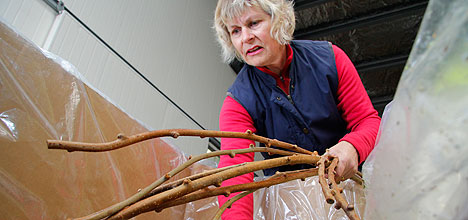
Budwood fresh from orchards outside of the Bay of Plenty arrives in kiwifruit bins where staff, including Judy Trafford, sort, bundle and label it.
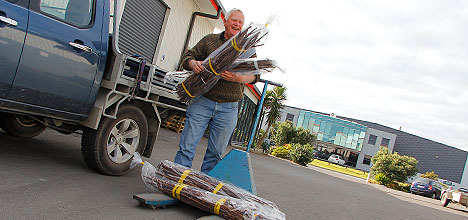 Bob Prowse of Whakatane loads enough budwood to graft five acres of his Whakatane orchard with the new Gold3 kiwifruit variety.
Zespri general manager grower and government relations Simon Limmer says sourcing, recording and distributing the budwood for the new gold and green fruit called Gold3 and G14 is a significant logistical operation but so too is grafting it onto vines on 2274 ha of orchards.
It is the impact of the bacterial disease Psa-V which has prompted such a huge conversion to new varieties in just one season and 1750 hectares of the hardest hit Hort16A orchards, most of them in Te Puke, are among those to make the change.
'That represents about 65 per cent of the total Hort16A in the industry. We have never seen anything on this scale in this kind of time frame before.”
In addition, some Hayward green orchards will also convert to new varieties and some orchards are likely to be grafted during the second window of opportunity in November.
Throughout the Bay of Plenty teams of workers are cutting back mature canes and grafting budwood onto bare kiwifruit `stumps'. In Psa infected orchards, the plant material is buried, (which is Kiwifruit Vine Health's first recommended way of disposal) or burnt under controlled conditions to avoid spreading the bacteria. The removal of most of the badly infected Hort16A vines from Te Puke is hoped to decrease bacteria inoculum levels in that area.
Collecting enough graft material has been a huge operation and its coming from established new orchards outside the Bay of Plenty.
'Because of Psa we can't collect budwood from the Bay of Plenty and most of it is coming from orchards in Hawkes Bay and Gisborne with some from the Waikato, Northland and the top of the South Island. We are confident we can source enough budwood to meet demand, however, harvesting budwood does come at a cost to growers as it will reduce their crop for next season.”
One hectare of established orchard generally yields enough budwood to graft 100 ha of vines and each hectare requires 1000 pieces of budwood, or two buds per vine.
Once the budwood is harvested it is sent to a Bay of Plenty coolstore where Zespri staff are preparing it for distribution to license holders.
'Every piece of budwood is traceable. We know where it has come from and where it is going.”
The budwood is best used as quickly as possible but because it is kept in a coolstore, it will remain viable at least until November.
The new gold variety G3 doesn't have the distinctive `beak' of Hort16A, marketed as Zespri Gold and so far has shown more tolerance to Psa-V than Hort16A, but Simon says it is still susceptible to the bacteria.
'The most testing time with the juvenile grafted vines will be this spring which is when they will be at most risk of infection and also when they will demonstrate the extent of any infection they may have.”
Orchardists will need to do all they can to protect their vines and a series of field days are being held by both Zespri and postharvest companies to support growers and outline best practice management procedures.
'We are not out of the woods regarding Psa with G3 or with Hayward, which we know is more tolerant that Hort16A but not immune to it.”

0 comments
Leave a Comment
You must be logged in to make a comment.