


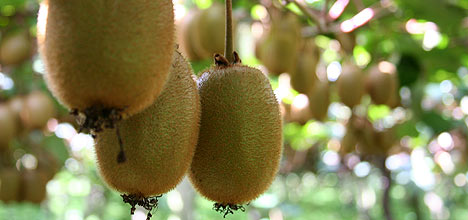
Kiwifruit growers will find out soon if their bids to graft Zespri's new varieties have been successful.
Communications manager David Courtney says all successful bidders will receive notification on Monday June 18 about the outcome of their bids following allocations of budwood made by the evaluation panel four days earlier.
Applications for fixed price, closed tender and gold-one-for-one bids (for growers who already hold gold Hort16a licenses) closed on May 31 and since then Cooney Lees Morgan lawyers have been are validating all of the bids which David says has been a time consuming process.
Up for tender are the new gold called G3 which has so far shown more resistance to Psa-V than Hort16A and a green called G14. July is considered the best month for grafting new budwood to existing root stock as the vines are dormant but there is another opportunity in spring.
While time frames for fixed price and closed tenders have been set, transitional licences will remain open over time, giving existing gold growers the opportunity to make decision when they are ready.
The transitional price per hectare for G3 has been set at $8000 and growers don't have to pay it all up front. G3 is a high yielding variety which should see growers have reasonable volumes to harvest in two seasons but G14 takes a little longer reach production.
Potentially up to 1500 ha of vines could be grafted, making it the largest transition to new varieties
G3 has shown more tolerance to the aggressive bacterial disease Psa-V than Hort16a but it is still susceptible to infection.
Simon Limmer, Zespri's general manager for global supply says growers were warned to consider the risks of grafting to new varieties very carefully.
'Psa is the driver here. We would not be doing this on such a scale if Hort16 (gold kiwifruit) was not so fundamentally flawed when exposed to the disease. When it comes to Psa we only know what we know today.”
The bacterial disease Psa-V has devastated Hort 16A gold orchards, hitting Te Puke growers particularly hard. 'Between 500 and 600 ha of Hort16A vines have already been removed and we could see the same numbers again as growers conclude this is their last season so we expect there could be 1200 to 1500 ha eventually.”
To date 1211 orchards have the disease, the majority of them in the Te Puke area.

0 comments
Leave a Comment
You must be logged in to make a comment.