


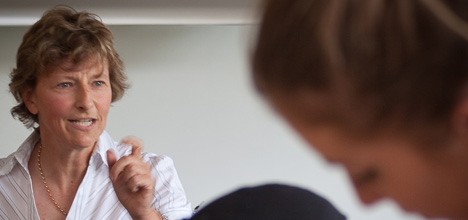
A soon to be conferred University of Waikato Masters of Education student in Tauranga has undertaken research which shows the benefit of involving children in the planning of their own learning.
Chris Brough is conferred with a Masters of Education from the University of Waikato this week.
In achieving her first class honours masters, Chris Brough spent a year researching what happened when three primary school teachers used student-centred curriculum integration techniques in their classrooms.
'The teacher involves them in classroom decisions and curriculum planning,” says Chris.
'It's a more democratic way of teaching because it engages the children in their own learning rather than the teacher planning an entire unit in advance.”
In practice, student-centred curriculum integration takes place in many classrooms when teachers expand an unplanned 'teachable moment” into one or more sessions, says Chris.
'In one school, a digger arrived and the class went to watch.
'The children were fascinated by the different soil colours in the hole, so even though it was completely unplanned, the teacher worked with the children and expanded this into a bigger study.”
She says while more schools are trying to bring these democratic principles and practices into their classrooms, this way of teaching is a more complicated approach and can be quite scary to new teachers.
'Pre-planning ensures teachers are meeting the curriculum standards.
'Taking a student-centred approach means a teacher needs an open mind about where the learning is heading while still adhering to the curriculum.”
Working with three recent graduates based in North Island primary schools, Chris supported the teachers, who had all studied student-centred curriculum integration at the University of Waikato, to practise the approach in their classrooms.
In one class, a chance comment by one child about wanting a bigger classroom, spurred a study that lasted the whole year.
'At all times the teacher involved the children in planning what they wanted to find out about, for example, one unit led the class to make square metre cubes to measure their classroom.
'Children were totally engaged – often they didn't want to stop for lunch – and they could apply their knowledge to other contexts meaning learning was retained over time.”
Chris says findings indicated the technique provided relevant, engaging and equitable learning environments for children.
Prior to starting at the university in 2004 as a teaching fellow, Chris was a primary school teacher for 10 years and a strong advocate for student-centred curriculum integration.
Her masters qualification is conferred on Friday, April 29, at the University of Waikato Tauranga campus graduation.

1 comment
I get it..
Posted on 24-04-2011 20:06 | By Tony
The Kids figure out what they need / want to learn and the Teachers get paid more .ahhh I get it
Leave a Comment
You must be logged in to make a comment.