


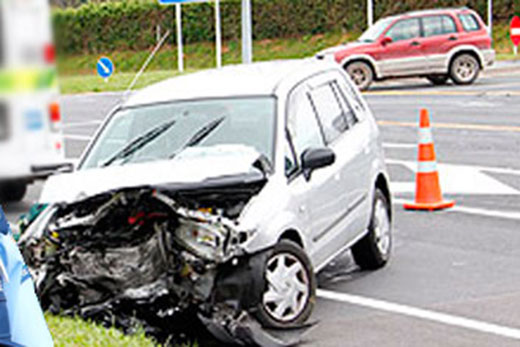
It's the part of the job that every Police officer dreads: knocking on the door of a family to deliver the awful news that their loved one has been killed in a horrific road crash.
This Easter, Police and road safety agencies are urging all road users to play their part in making the long weekend a happy and safe one for all.
Police don't want to attend any horrific crashes these Easter holidays.
The official Easter Holiday period begins at 4pm on Thursday and ends at 6am on Tuesday, April 7.
Road Policing National Operations Manager, Inspector Peter McKennie, says Police will be firmly focused on preventing risk-taking behaviour that is responsible for killing and injuring far too many people on our roads.
'This includes targeting high risk driver behaviour that puts all road users at risk – including drink and drug-impaired driving, speeding, and failing to wear safety belts – including for children and other passengers.
'In addition to breath testing and other high visibility policing tactics, we will be enforcing a reduced 4km/h speed threshold as we have done for every other long holiday weekend since Queen's Birthday Weekend in 2010.”
This means anyone caught exceeding the posted speed limit by more than 4km/h by a speed camera or a Police officer can expect to be ticketed.
Five people died on the roads last Easter, and three in 2013.
The only fatality-free Easter ever recorded was in 2012.
The latest available Ministry of Transport data shows around 30 per cent of all fatal crashes and about 15 per cent of injury crashes include alcohol or drugs as a contributing factor, which in 2013 translated to 78 people killed and another 1666 people hurt.
The same data shows almost identical proportions of people killed and injured in crashes where speed was a contributor – with 83 people dying and a further 1863 people injured during 2013 as a result – while 37 died during 2013 in crashes where the occupant was not restrained.
'This isn't rocket science,” says Peter.
'There are really simple things that everyone can do to make us all safer on the road, whether it's taking a few seconds to put a safety belt on, stopping a drunk driver from getting behind the wheel, reporting instances of dangerous driving, or simply making sure you plan your journey and drive fresh so you reach your destination safely.”
For its part, Police will again be maintaining a highly visible presence on the roads, targeting known hot spots and high risk driver behaviours.
This includes:
*Breath testing every driver stopped, regardless of the time of day or reason for the stop – including continued enforcement of new reduced adult alcohol limits.
*Enforcing speed limits through a reduced 4km/h threshold throughout the official holiday period, as with previous holiday weekends.
*Ensuring all adults are wearing their safety belt, and that children and younger passengers are properly restrained.
'Our officers do not want to see anyone killed or injured or their friends and family torn apart this Easter by a crash that could easily have been avoided,” says Peter.
'But we need everyone to step up and play their part, as road safety is everyone's responsibility.”
This means everyone driving sober, at the appropriate safe speed for the conditions, and wearing their safety belt.
'Putting away distractions such as the cellphone and driving to the weather and traffic conditions are among other things that can make is all safer, while friends, family and whanau can also make a real difference in ensuring mates and loved ones are safe and sober when getting behind the wheel.”

3 comments
Wisechief
Posted on 03-04-2015 08:48 | By Wise Chief
Can we have a list of these High Risk Driving maneuvers which Police State will be using to justify full blown road blocks and testing everyone for breath Alcohol while at it and does that include no warrant or no regos? I mean we Kiwi's get the message PS we all need to stay locked in our homes rather than run the risk of being apprehended for even the most minor of infractions when using a vehicle to get about in a country with less than 0.8% urbanised and where much of the country doesn't have public transport not that police care,they stating such transport is privileged not a right like the horse or acknowledge for many a necessity to survive. Obnoxious the fines quota used to fill private prison regime which Police State now requires of us Island Imprisoned recently invaded by Poms Asians and Chinese aye KIWI's.
Statistics
Posted on 03-04-2015 11:25 | By CC8
Statistics are a waste of time when quoted out of context, only used to support one point of view. For example ......"37 died during 2013 in crashes where the occupant was not restrained." So ,the road toll was 253 in 2013, does that mean that only the other 216 who dies WERE wearing their seat belts? In which case it would seem as if the statistics are saying it is safer to NOT wear a seatbelt!!!
Wise Chief
Posted on 03-04-2015 12:20 | By How about this view!
Whilst most of your racist ranting is not worth the effort that you expend on typing it, I have thought for a while now that our justice system could be seen at times as only there to pay for itself, with it's increasing use of fines over punishment for indiscretion. Fines are being increasingly ignored as an irrelevance by all sectors of our society. Those that can't pay, DON'T and those that can pay, learn nothing and move on. I am beginning to think that a more appropriate punishment (And one that would disadvantage ALL sectors of society, more or less, equally) would be to remove their privileged of being ALLOWED to drive on the roads and BAN them from driving, even for minor offences such as only having one headlight working (A warrant requirement) and have our traffic police establish MORE checkpoints to catch defaulters for increased punishment.
Leave a Comment
You must be logged in to make a comment.