


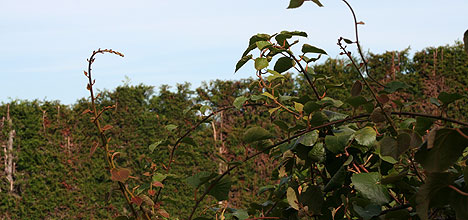
Collaboration between the Bay of Plenty Regional Council and New Zealand Kiwifruit Growers Incorporated is reducing the number of wild kiwifruit in the region.
Using innovative approaches to controlling the pest over the past eight years, the two organisations have destroyed more than 25,000 wild vines, including almost all of the older, large vines.
Council's senior pest plant officer John Mather says wild kiwifruit had existed in the Bay of Plenty since the 1970s. Each kiwifruit has about 1100 seeds with ripe fruit providing an easily accessible and attractive food source for birds. Wild vines can easily establish through bird droppings.
'Wild kiwifruit can form mounds of tangled stems or grow up and over native and exotic trees,” says John.
'If left uncontrolled, wild kiwifruit can strangle trees causing them to die or fall.
'Without active control areas of forest and native bush might be completely smothered in parts of our region.”
NZKGI funds the control operations while the regional council monitors the work and identifies where control is required, however, landowners are responsible for controlling wild vines.
Group manager land management Warwick Murray says the collaborative effort is working well.
'We haven't cracked it yet though. It will require ongoing vigilance and effort from kiwifruit growers and farmers if we are to keep on top of the problem.
'It is particularly important for growers to clear unwanted fruit from vines and for farmers who use reject fruit as stock feed to cover it while it's in storage.
'This can make a big difference in reducing opportunities for birds and animals to spread the seed.
'We are also working with the industry to trial composting and other processing options which will reduce the amount of reject fruit distributed into the environment and available to birds.”
NZKGI president Peter Ombler says kiwifruit vines grew very well in the Bay of Plenty.
'When they're on an orchard that's a good news story for the region, driving around a fifth of the region's economy.
'When the vines establish themselves off the orchard, growers recognise that's not such a good story and NZKGI has been happy to assist with the control of wild kiwifruit in the Bay of Plenty.”
In a related development, an initiative led by Scion and supported by Zespri International converts waste kiwifruit into bio-plastic.
Waste fruit and fruit process residues can be transformed into ‘spifes' – the combined spoon and knife utensil used to eat kiwifruit.
There are also plans to make packaging with the bioplastic for export kiwifruit, reducing the estimated 50,000 tonnes of waste kiwifruit in the Bay of Plenty.
Previous studies involving kiwifruit growers, fruit processors, the regional council, Zespri International and Scion have helped to identify the primary sources of the fruit and related residues in the region which could be suitable for bioplastic developments.

0 comments
Leave a Comment
You must be logged in to make a comment.