


At mention of 'smazak” 10-year-old Nicholas Benfell of Mount Maunganui drifts into sensory heaven. 'Best stuff in the world,” he enthuses.
Smazak is a Czech national dish of edam or camembert cheese dipped in egg and breadcrumbs and shallow-fried and smeared with sauce.
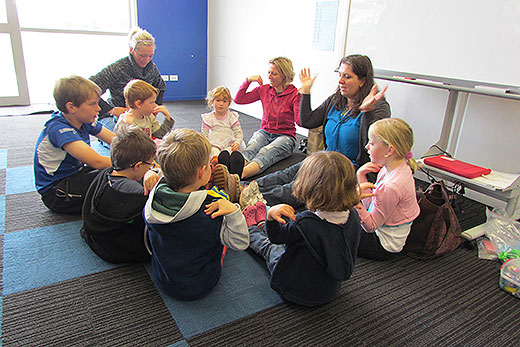
Far left is half ‘n' half Czech Kiwi Nicholas Benfell at Sunday school in Arataki.
It doesn't carry a NZ Heart Foundation red tick endorsement, but for a moment, just one indulgent moment, Nicholas can forget he's spending a sixth day at school this week – and every other week.
For Nicholas 'smazak” is one of the blessings of being Czech – well half-Czech. His mum is from the republic. The downside is this Czech school is on a Sunday morning – 'that sucks” says Nicholas.
What 'sucks” is probably being dragged from under the duvet rather than the school itself.
Because this Kiwi is enormously proud and patriotic about the half of him that is Czech.
'I love both countries...equally,” he says, demonstrating a diplomacy beyond his 10 years.
'NZ has wonderful beaches – The Czech Republic has the world's best ice cream. New Zealand has nice weather, Prague has lots of history.” Nicholas is in the privileged position to enjoy both.
And as you would expect of a 10-year-old, he accepts and respects the two hours of Czech school that immerses him in his second language, teaches him of the castles and rich turbulent history of this landlocked European nation, the tastes of the republic – the dumplings goulash, schnitzel and croquets – and the songs.
The school came about because one woman from 18,000 kilometres away imposed her will – a Czech grandmother and matriarch, who demanded a connection with her Kiwi-born grandchildren.
But to skype ‘babbicka' or ‘nanna' the children needed at least a smattering of the mother tongue and to learn Czech they needed to go to school – Sunday Czech School.
The Czech Government agreed with ‘babbicka'. It chips in the ‘koruna' – Czech dollars – to keep the culture thriving in New Zealand, to maintain the connection.
The library of Czech storybooks at Sunday school is a product of that goodwill and investment.
And on the mat, every a Sunday at the Arataki Community Centre, 10 children from toddlers to teens slip comfortably in and out of two languages.
'Nedele 19 Rijen 2014” they chorus to start the day, the date on the blackboard.
They are children with names like Pepino and Misha (Michael) and a gorgeous little strawberry blond dual passport-holder called Andteg, pronounced ‘Undraka'. At just five she prefers the more exotic Czech derivation of her name. Good style!
Parents from either ends of the world watch on proudly at Czech school. And where children grasp things easily, parents struggle.
'We use the Czech words for potatoes, milk, butter and bread at home. I can understand it – but I can't speak it. It's a difficult language,” says a Kiwi father of little Czech children.
And it's interesting that some of our ex-pat Czech's have developed a disconnection with the Czech Republic, things Czech and other Czechs.
'I mean if you wanna hang out with Czechs and do Czech things you should have stayed in Prague,” says one new New Zealander with a hard-to-shake Czech accent, carrying the finest ‘jablecny strudl' seen outside the republic.
Good things can come of an amalgam of two cultures – like the children and the strudel. It was still warm from the oven, dusted with icing sugar, oozing fragrant sticky apples – like food from heaven.
Děkuji, a Bůh vám žehnej – or thank you and God bless – as they say in Prague, and now Bayfair.

0 comments
Leave a Comment
You must be logged in to make a comment.