


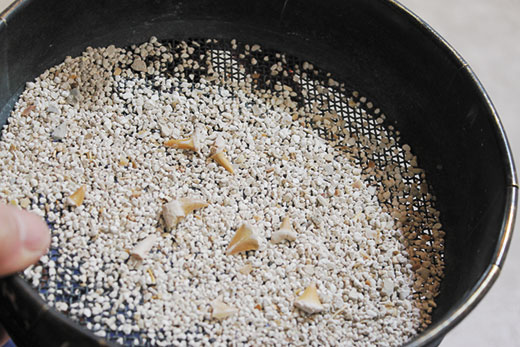
Like an archeologist on a dig, Terry Smith carefully sifts a sample of fine powder to reveal fish teeth and bones that are millions of years old.
It's easy to find the remains in the massive pile of phosphate, explains Terry, who is the chemical and process manager at Ballance Agri-Nutrients Tauranga, because it's from the vertebrae and teeth of those ancient marine creatures that phosphate is largely formed.
Fish teeth, millions of years old, are easy to find in phosphate imported from Morocco.
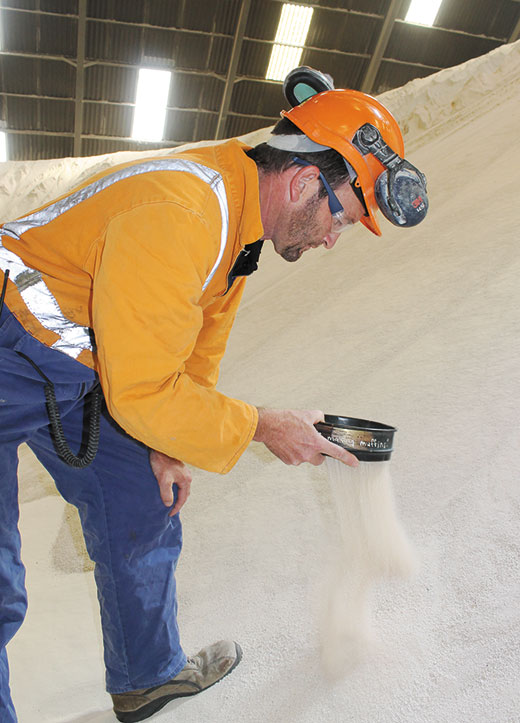
Finding fossils - Terry Smith, chemical and process manager at Ballance Agri-Nutrients Tauranga sifts fish teeth from phosphate.
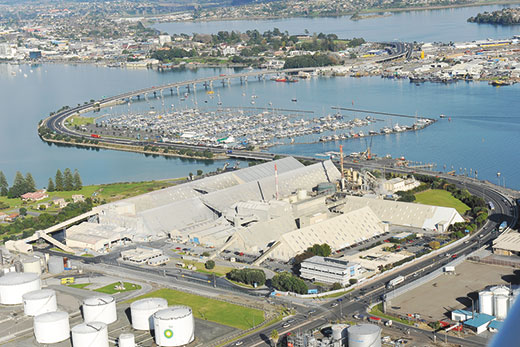
An aerial view of the Ballance facility at Mount Maunganui.
This particular shipment arrived at the Ballance facility via the Port of Tauranga, shipped from Morocco where it is mined from what was an ancient sea bed, now 100km from the coast.
'Phosphorus is vital for plant growth and health, but in this form plants can't use it,” says Terry. 'The amount of phosphorus it contains is also inconsistent.”
Creating a plant-available fertiliser, which contains a consistent amount of nutrients, is what happens at the Ballance Tauranga plant.
Every day thousands of people drive by and others fly over the facility on the Mount Maunganui-side of the harbour bridge, but few have any idea what happens there.
According to Terry, the facility is part of the food industry and he makes a pretty compelling argument to support his claim. Much of what we eat, he says, relies on animals – cows, sheep, deer, even goats – converting grass into protein in the form of milk or meat. To do that they need to eat grass, which is itself well-nourished by fertilisers.
'We can't keep taking from the soil without replacing what plants extract. Each year we export hundreds of tonnes of nutrients in milk and meat which will never be returned to our soils, so we have to replace them.”
It's not just through exports that nutrients are lost. 'Every day New Zealanders are ‘depositing' phosphorus in our sewerage systems or septic tanks, which don't generally end up back in the soil.
'One litre of adult human urine contains about 1.4 grams of phosphorus salts, which amounts to about 0.11 grams of pure phosphorus – so that's a lot of phosphorus that is out of reach of pasture plants.”
New Zealand soils are also deficient in a number of elements needed for healthy pasture growth.
Terry is fascinated by the history and chemistry behind fertilisers. He recounts how it was German scientist Henning Brand, who in 1669 discovered phosphorus when he boiled urine until it produced a liquid which gave off a pale green glow and he called phosphorus – a Greek word for 'light-bearing”.
'He was looking for the philosopher's stone, to turn base metals into gold,” says Terry, who reckons the scientist in fact discovered something much more valuable. At the Ballance facility it's another element, also with a distinctive colour, which is required to help make phosphorus into a form which plants can use. A mountain of high-visibility yellow sulphur, this time mainly a by-product of the Marsden Point oil refinery, fills a bunker.
It is destined to be heated in a furnace to produce sulphuric acid, which once combined with the phosphate forms the fertiliser known as superphosphate.
'How to make superphosphate was discovered in the 1840s and though it's been refined, we pretty much use the same principles today,” says Terry.
Converting sulphur to sulphuric acid produces extreme heat – more than 1000 degrees Centigrade – and water is used to cool the gases produced.
As a by-product of the process, Ballance runs steam turbines which produce electricity for the plant's own consumption and also feed power back into the grid – enough to supply 2000 homes.
The superphosphate formed from phosphate rock and sulphuric acid passes through a further stage to refine its particle size for easy application by ground or aerial spreaders.
Terry, more correctly Dr Terry Smith, who has a number of degrees including a Doctor of Philosophy, Chemistry and Environmental Chemistry from Waikato University, says without the petroleum industry, the world's food supplies would be under threat.
'Sulphur is mainly a by-product of the petro-chemical industry. Some comes from volcanic sources [like the long defunct mine of White Island] but that's rare. While it's easy to say we could stop producing so much meat and milk, the fact is much of our farmland isn't suitable for cropping, so we need to grow pasture to feed animals who collect nutrients for us.
'Even if we all turn vegetarian and grow and eat lots of crops, we eat because the food is nutritious; and to produce nutritious food you need nutrients, and that is what fertilisers provide.”

1 comment
interesting
Posted on 10-03-2014 18:41 | By grasser
Food for thought or Thought for food.What are we wasting?
Leave a Comment
You must be logged in to make a comment.