


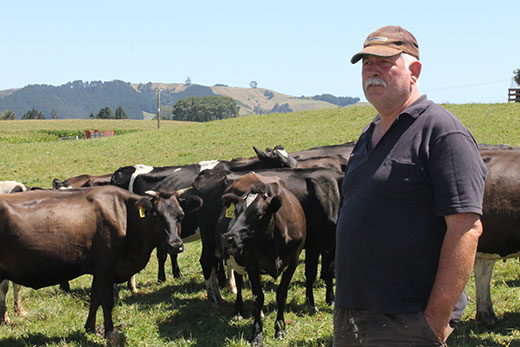
Cor Verwey is a conventional dairy farmer with a bent for the unconventional when it comes to management practices, provided it enhances the operation's bottom line.
Cor Verwey is a pragmatic farmer who believes in keeping things simple, but effective.
Christine and Cor Verwey, who have farmed the former drystock land on the outskirts of Te Puke for 25 years, consistently out-perform the area's farming benchmarks in almost all areas of farm production from milk solids to pasture dry matter.
Cor and his son David shared their philosophies and management techniques with about 30 farmers and rural professionals at a DairyNZ discussion group day in late January, which included a walkover part of the farm to look at the herd and two different pastures. Organised by Kevin McKinley of DairyNZ, it was the first in the district for 2014.
'The purpose of our discussion group is to review the physical performance of this farm and to look for opportunities to enhance it, to help the host business growth objectives,” says Kevin.
The Friesian and Friesian-cross cows appeared keen to hear what was said about them, as they moved quietly closer to members of the discussion group, standing in their paddock. Cow number 24, perhaps bored with the lack of action, calmly walked on in for a pat from Cor as he explained the farm's policy of testing for but not treating mastitis.
Cows with infection are isolated and looked after, returning to the herd once they've recovered, says Cor. However, repeat infections could see them culled. Cell counts are low and the 460 members of the herd enjoy generally good health, thanks partly to being well fed and to genetics.
'I breed cows for longevity. There's no point in having a high producing cow which only lasts a few seasons.”
Cows are not induced and no drugs are used to improve timing of pregnancy.
'Feeding PK [Palm Kernel] in the spring saw mating improve heaps. We also put more urea on in spring to feed the cows well for mating.”
The cows aren't herd-tested either, because Cor doesn't believe it offers any financial benefits.
'Last season the herd animal health costs were $40 per cow.”
The cows produced 177,560 kilograms of milk solids in the 2012-2013 season, compared to the benchmark of 144,540 kg/ms and the aim for this season is 195,000 kg/ms. The cows were in milk for 268 days, compared to the benchmark of 227.
As well as good quality pasture, the herd also receives 550kg per cow of palm kernel; and maize silage is grown on the farm and a run-off to extend lactation.
Calves are grazed off-farm from October 1 and return home in-calf in July.
In March last year, when the farm, like all others in the district, was suffering the effects of a prolonged drought, Cor and David mixed seed of the new Shogun tetraploid hybrid ryegrass with lime and spread it on the pasture – and prayed for rain.
When the rain eventually came, the new grass quickly became well established. 'We did 95 per cent of the farm – and I kick myself that I didn't sow more.”
The farm has its own fertiliser spreader, which has made it easier for Cor and David to act on the information received from soil tests from individual paddocks.
While it's more expensive to soil test the whole farm, the results appeal to Cor's financially-prudent nature. 'I don't mind spending money if it's going to save me money. With these tests, I'm not using as much fertiliser.”
Rob Adam of Ravensdown says new technology, including GPS systems and Ravensdown's joint ventures with companies operating variable rate fertiliser spreaders, now make taking samples from individual paddocks worthwhile – because spreaders have the ability to apply what is needed and where.
'This farm has three different soil types; sandy, loam and one we've called ‘complex'.
It has high areas, low areas; areas which are wet and those which are dry.”
The soil tests results differ from paddock to paddock and clearly showed areas which were low in particular nutrients and those which didn't need any more. The testing of individual paddocks costs between $2500 and $3000 but can result in savings in fertiliser costs, says Rob.
The recommendation is to repeat them every five years, but Cor may have the tests done again next year to see what gains have been made.
Effluent is spread on about 80 hectares of the 122ha effective unit and those paddocks required little extra, apart from sulphur, says Cor.
Pioneer's regional manager Robin Billett says effluent contains a range of nutrients derived from what the cows have been eating, including palm kernel and maize silage.'Using farm effluent can be worth $500 to $1100 per ha in savings on fertiliser costs.”
David and Cor have also included chicory and plantain in some of their pastures; a mix the cows find particularly palatable. In order to avoid damaging the more delicate species, they don't break feed it, instead putting the whole herd into the pasture for 12 hours before removing the cows to graze elsewhere.
Cor's farming principles are: 'Keep it simple, run a low cost profitable operation, be mindful of farm working expenses”.
And Cor says he's allergic to metal – 'the kind which is shaped into big expensive farm machinery”.

Cow number 24 wandered up for a pat as Cor Verwey talked to a DairyNZ discussion group on his Te Puke farm.
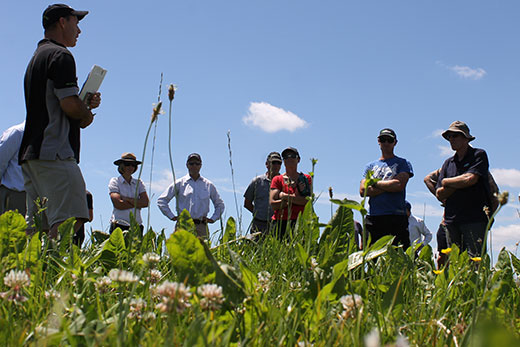
A pasture mix, including chicory and plantain, is proving popular with cows on the Verwey farm at Te Puke.

0 comments
Leave a Comment
You must be logged in to make a comment.